Last updated October 30, 2026
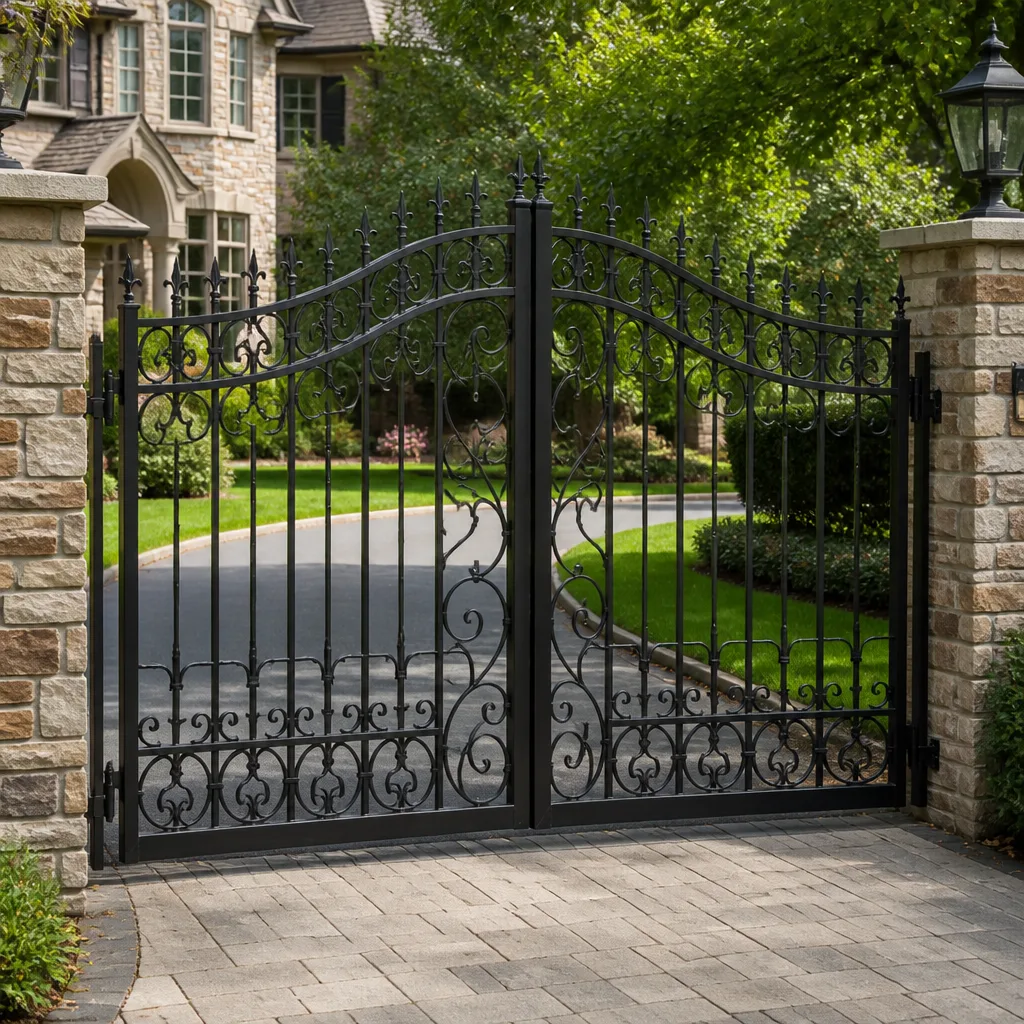 Wrought iron
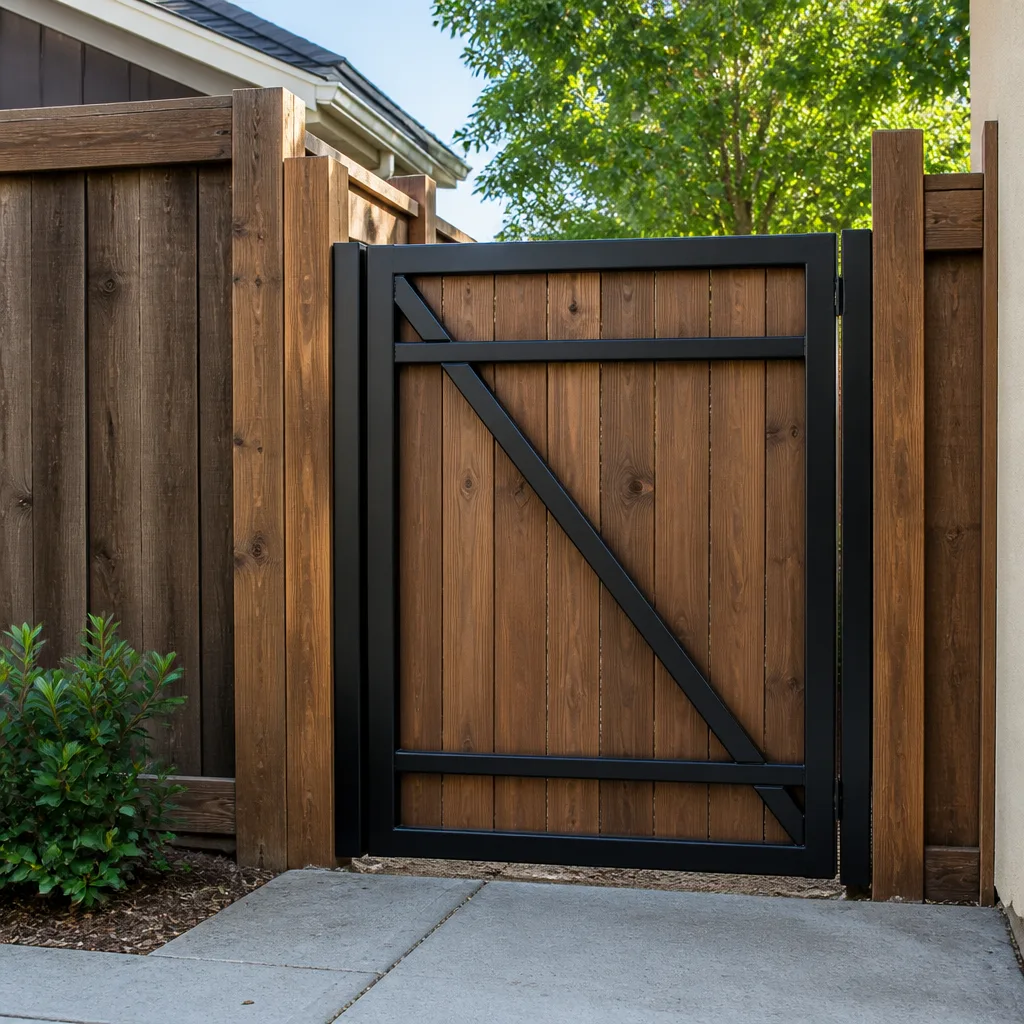 Wood & steel frame
 Farm & ranch
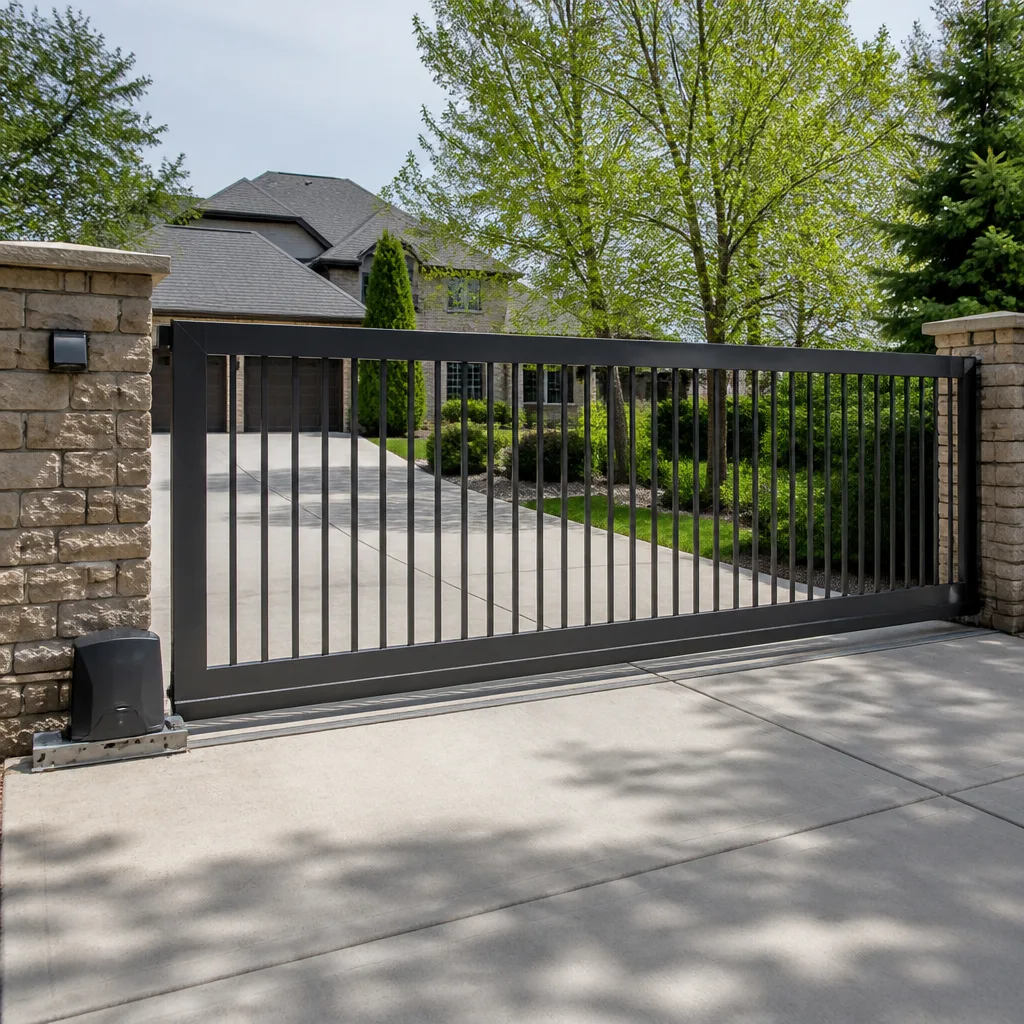 Sliding driveway gates
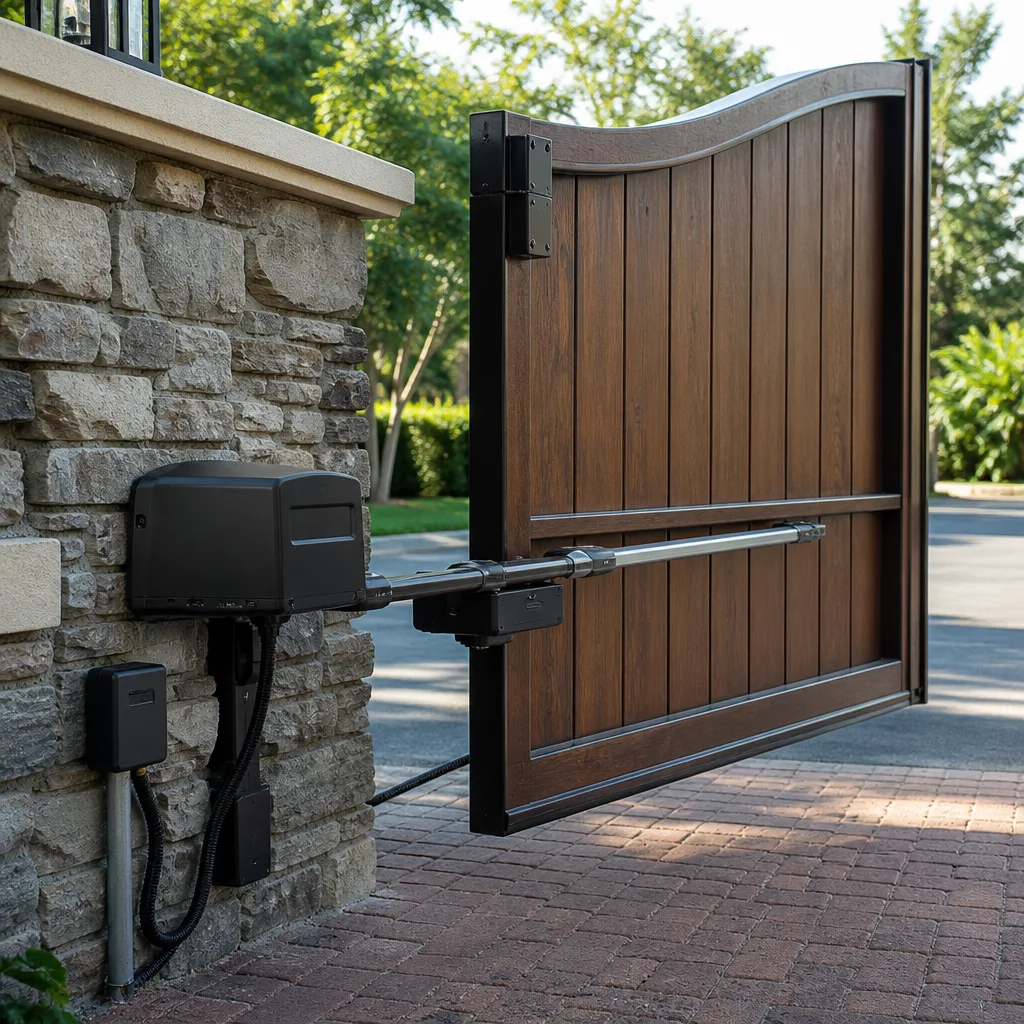 LiftMaster operators
Free on-site gate assessment - hinges, posts, and your LiftMaster or Nice gate operator checked before anything is quoted
The assessment is free and the quote is the invoice.
Get your free estimateThe Complete Gate Repair Guide for Miami Gardens Homeowners
Most gate repair guides were written for Phoenix or Dallas. Dry heat, occasional dust, predictable seasons. Miami Gardens averages 62 inches of rain per year and sits roughly 14 miles from the Atlantic. Your gate is fighting corrosion, water intrusion, and lightning surge damage that those guides never account for. This guide maps every major gate system component to the Miami-specific failure mode most likely to kill it first, so you can diagnose problems before they become a stalled car at 7 a.m. or a gate that won’t close before a storm rolls in.
Quick Answer
Gate repair in Miami Gardens typically means diagnosing either a mechanical failure (hinges, rollers, rack gear, track alignment), an electrical failure (operator motor, control board, loop detector, transformer), or a combination of both. Most single-component repairs run $150 to $450, while full operator replacement can range from $700 to $1,800 depending on brand and swing versus slide configuration. Given the salt-laden humidity and daily thunderstorm cycle here, the most common root cause we see is moisture intrusion into control boards and limit switches, followed by surge damage to transformers during summer storm season.
Styles & brands we work with
Table of Contents
- Why Miami Gardens Weather Kills Gates Faster
- Mechanical vs. Electrical Failure: How to Tell the Difference
- Component Lifespans Calibrated for South Florida
- Hurricane Season and Gate Operator Damage
- What Your Gate Brand Tells You About Likely Failures
- What’s Genuinely DIY vs. What Requires a Specialist
- Repair vs. Replacement: How to Decide Without Getting Pushed
- A Miami-Tuned Maintenance Schedule That Actually Prevents Repairs
Why Miami Gardens Weather Kills Gates Faster
Here’s the counterintuitive truth: your gate isn’t failing because it was cheaply made. It’s failing because the environment it lives in is one of the most aggressive corrosion and surge environments in the continental U.S. for outdoor electronics.
Three factors work together here in Miami Gardens:
- Salt-laden humidity: Warm, moist Atlantic air carries dissolved salt particles inland. Those particles settle on exposed metal and into any unsealed enclosure. Inside a control board housing, the salt attracts moisture, which bridges traces on the PCB and starts electrolytic corrosion. This is the number one cause of phantom operator faults that reset when the board dries out, then return after the next rain.
- Daily thunderstorm cycle: From May through October, Miami Gardens sees near-daily afternoon storms. Lightning strikes within a mile of your property induce voltage spikes on the low-voltage wiring that leads back to your operator. These spikes don’t always kill the board instantly. They degrade MOVs, optocouplers, and secondary fuses over time. Many boards that “just died” were actually weakened by a surge 30 days earlier.
- Heavy rain and water intrusion: Gate operators are rated for outdoor use, but the sheet-flow and pooling patterns in Miami Gardens hardpan and clay-heavy soil mean water can stand under sliding gates. Splash-up into the motor housing is common, especially on the lower side of a mounted operator. Some gates in neighborhoods like Andover and Norland are on lots that drain toward the gate post, which accelerates corrosion of the motor shaft and limit switch assembly.
What to inspect first after any prolonged rain period: open the operator cover and look for condensation, water staining, or white salt deposits on the board. If you see any of the three, the board is already in distress even if the gate still opens today. We mention this because most homeowners never open the cover until the gate is already dead. A visual check after every heavy rain system takes two minutes and can prevent the difference between a $200 cleaning and a $700 board replacement.
Mechanical vs. Electrical Failure: How to Tell the Difference
This is the single most useful diagnostic distinction in gate repair, and most people get it wrong. They hear a grinding sound and assume the motor is shot. Or the gate won’t open and they think a hinge is rusted. In our experience across Miami Gardens homes, electrical issues and mechanical issues each account for roughly half of all failures, but the fix for one is radically cheaper than the fix for the other. Here’s how to tell them apart before calling anyone.
The 90-second diagnostic:
- Does the operator run at all? Put your hand on the operator housing. Have someone trigger the remote. If you feel the motor hum, click, or struggle, the electrical system is doing its job and the problem is mechanical. If there’s dead silence, no click, no hum, the problem is electrical.
- Release the manual disconnect. Most operators have a release handle or key. Pull it and try pushing the gate by hand. If the gate slides or swings freely, the mechanical structure is fine and the problem is in the operator, limit switches, or control board. If the gate is stiff, catching, or won’t move at all, you have a mechanical failure: seized rollers, a bent track, a broken hinge leaf, or a rack gear with stripped teeth.
- Listen for the symptom pattern. A clicking relay with no motor movement points to a failed capacitor, transformer, or seized motor. A motor that runs but the gate moves only a few inches points to a slipping drive belt, stripped gear, or physical obstruction. A gate that opens but won’t stop at the limits points to limit switch failure from moisture intrusion.
Why this matters: mechanical repairs are usually simpler and cheaper. A seized roller on a sliding gate in Miami Gardens might run $100 to $250 to replace. But an electrical fault in a control board can mean a $400 to $900 repair depending on the board model. Knowing which domain you’re in before a technician arrives means you can’t be talked into an expensive board replacement when the real problem is a $15 hinge bushing. Our guide to Gate Repair in Miami Gardens covers this diagnostic flow in more detail for both swing and slide configurations.
Component Lifespans Calibrated for South Florida
Manufacturer lifespan charts are written for temperate climates. A liftgate motor that lasts 12 years in Ohio may last 7 in Miami Gardens. Here are the realistic numbers we observe across the equipment we service, with the South Florida failure accelerators called out.
| Component | Manufacturer Average | Miami Gardens Realistic Average | Primary Accelerator |
|---|---|---|---|
| Gate operator motor (swing) | 10-12 years | 6-9 years | Humidity ingress past shaft seals |
| Gate operator motor (slide) | 12-15 years | 7-10 years | Splash-up corrosion on lower mounts |
| Control board | 8-10 years | 4-7 years | Salt-air corrosion on traces + storm surges |
| Battery backup | 3-5 years | 2-4 years | Heat exposure inside unventilated cabinets |
| Loop detector | 8-12 years | 5-8 years | Lightning-induced damage on coil wiring |
| Hinge assembly (heavy swing gate) | 15+ years | 5-8 years | Rust at weld points from salt-laden rain |
| Rollers (slide gate) | 5-7 years | 3-4 years | Hardpan sand grit plus water pooling in track |
| Rack gear | 10-12 years | 5-7 years | Tooth wear accelerated by gate misalignment |
| Photo-eye / safety sensors | 6-8 years | 3-5 years | Constant sun exposure degrading lens coatings |
| Transformer | 10-15 years | 4-8 years | Voltage surges during daily storm season |
Note the pattern: every single component fails faster here. Not because of cheap manufacturing, but because constant moisture, airborne salt, and lightning activity stack damage over time. This is also why a “refurbished” operator that runs fine in Texas may fail within 18 months in Miami Gardens. The seal integrity and board condition required for this climate is a genuinely different bar than the rest of the country.
Hurricane Season and Gate Operator Damage
Hurricane season in Miami Gardens isn’t just a threat to your roof shingles. It’s the single largest source of gate operator damage we see every year, and the mechanism isn’t what most people expect. It’s not wind. It’s the combination of sustained moisture and electrical surges.
The three damage paths:
- Lightning-induced surge damage: A storm cell within a couple of miles sends voltage spikes down your power line and through any low-voltage loop wiring. These spikes are fast and hot. They degrade board components quietly. A LiftMaster or FAAC operator can function perfectly for weeks after a storm, then fail completely. The board was already damaged; the failure just hadn’t reached the threshold of total fault yet. This is the most misunderstood failure mode in Miami Gardens gate repair.
- Persistent moisture intrusion: Multiple days of heavy rain, especially when driven horizontally by storm winds, pushes water past weather gaskets and into enclosures. Once water reaches the board, electrolysis starts eating the copper traces. You’ll see green corrosion on the solder joints when this is the cause. It presents as random reversal, gate stopping mid-travel, or unresponsive remotes after rain.
- Mechanical loading failures: A gate that already has misaligned rollers or worn hinges takes much more stress from high winds. Swinging gates act as giant wind catches. If the operator is already pushing at capacity because a hinge is binding, a storm gust can shear the actuator arm or strip the gear teeth. Mechanical failures spike in the two weeks following any significant tropical system that passes near Miami Gardens.
What surge protection actually helps: In-line surge protectors on the power supply are a start, but they don’t stop the secondary path: induced voltage on loop wiring and peripheral wiring. For that, you need surge-rated isolation on the loop detector circuit and, on many boards, additional MOV or TVS diode protection on the terminal strips. Different brands have different surge immunity levels. BFT and FAAC boards tend to have robust onboard protection; some older Elite boards are notably more vulnerable. A technician who knows the difference between board families can tell you whether your operator is surge-hardened or surge-fragile. This is exactly the kind of diagnostic work covered under our Electric Gate Repair in Miami Gardens service.
What Your Gate Brand Tells You About Likely Failures
Factory-familiarity with the major gate brands means we don’t diagnose from scratch. We diagnose from pattern recognition. Each major brand has known weak points that present in specific, repeatable ways here in Miami Gardens. Here’s a sample of what we see most often.
LiftMaster Swing and Slide Operators
The most common issue we see with LiftMaster gear in Miami Gardens is limit switch degradation from humidity inside the enclosure. Symptoms: the gate stops a few inches short, or travels past the limit and jams against the post. The second most common is capacitor failure from heat exposure. LiftMaster operators are generally well-sealed, but when liquid does get in, the capacitor is usually the first component to go. If your LiftMaster is opening slowly or the gate shudders mid-travel, check the capacitor before assuming the motor is bad. In our experience, this diagnosis has saved many Miami Gardens homeowners a several-hundred-dollar motor replacement.
FAAC Swing Operators
FAAC boards in general show good durability against humidity. The failure point we see more often is the hydraulic actuator, especially on heavier gates. When a FAAC gate fails in Miami Gardens, it’s often a hydraulic pressure issue: the gate struggles to move, moves erratically, or drifts closed after opening. Hydraulic fluid degrades faster in high-ambient-heat environments with wide temperature swings. A pressure test on a FAAC actuator often reveals whether the problem is mechanical, electrical, or fluid-related before any component is replaced. This kind of brand-specific diagnosis is not something a generalist handyman can offer.
Mighty Mule Swing Operators
Mighty Mule units are popular for light residential swing gates, and they fail most often at the control board connection points. The quick-connect terminals and antenna connections corrode in salt air faster than the board itself. The symptom is a gate that responds intermittently or remotes that work only when standing very close to the operator. Many “dead” Mighty Mule boards in Miami Gardens are actually just corroded terminals. Cleaning the harness connection points and applying dielectric grease often restores function. However, when a Mighty Mule board is truly dead, replacement is usually more cost-effective than component-level repair, because the boards are not designed for bench repair the way FAAC or BFT boards are.
Elite Slide Operators
Elite operators, especially the slide models, have a known vulnerability in the power supply section. In Miami Gardens, unregulated line voltage during brownouts and surges takes out the bridge rectifier or the main filter capacitors. The symptom is a gate that runs fine one day and is completely dead the next, with no indication of power at all. If your Elite operator exhibits this pattern, particularly after a storm or a neighborhood power blip, suspect the power supply section before assuming the control board is fried. We can test this on-site and often repair the unit without replacing the entire operator.
This is what we mean when we say we know your gate brand because we work on all of them. A technician who only knows LiftMaster can’t tell you whether your FAAC symptom is safe to clear or whether a surge has compromised the safety loop. A technician who knows all nine major brands can tell you in minutes.
What’s Genuinely DIY vs. What Requires a Specialist
We’re not the kind of company that tells you nothing is DIY. Some gate maintenance tasks are genuinely safe for homeowners, and doing them can prevent failures. Other tasks are genuinely dangerous or require specialized diagnostic equipment. The boundary is clear.
Reasonable DIY tasks:
- Visual inspection after heavy rain: Open the enclosure and look for moisture, salt deposits, spider webs, or ants. Ants are surprisingly destructive to control boards in South Florida. If you see any of these, clean them off carefully with a dry cloth. This is safe and can prevent board-level failure.
- Lubrication of gate hinges and rollers: Use a proper lithium-based grease on swing hinges and a silicone-based lubricant on rollers and tracks. Avoid WD-40; it’s a solvent that displaces moisture but leaves no lasting lubrication. In Miami Gardens’s humidity, you need a grease that stays put.
- Clearing track debris: For sliding gates, remove leaves, soil, and debris from the track channel. After heavy rain, sand and muck from Miami Gardens yard runoff can build up in the track. A clear track prevents roller damage and motor strain.
- Remote battery replacement: This one is obvious, but it’s worth saying: if the remote is dim or you have to press it multiple times, replace the battery before suspecting the operator. A surprising number of “gate won’t open” calls in Miami Gardens are solved by a new CR2032.
Never DIY this:
- Anything involving control board wiring or terminal connections: The low-voltage wiring may look harmless, but the board itself is sensitive. A wrong connection can fry a $700 board instantly. More importantly, control boards are tied to safety systems: photo-eyes, edge sensors, loop detectors. Disabling or mis-wiring these can create a hazard where the gate doesn’t stop when a child or pet is in the path. This is not a place to learn by trial and error.
- Actuator repair on hydraulic or electromechanical swing arms: These units are under tension even when the gate is stationary. A charged hydraulic actuator can depressurize suddenly. High-tension gate springs on manually-assisted swing gates also store enormous energy. If a hinge pin is removed while a spring is tensioned, the results can be serious. This is genuinely dangerous work.
- Loop detector diagnosis or replacement: Loop detectors are buried induction loops that fail silently. Diagnosing one requires a meter that measures inductance, not just continuity. Replacing one means cutting a slot in your driveway. This is specialist territory.
The rule of thumb: if you can see it and it’s mechanical and exposed, it’s probably DIY-friendly. If it involves wiring, a board, a capacitor, or a hydraulic line, call someone who does this every day. Electric gates are not just convenience devices; they’re moving barriers that can weigh 400 to 1,200 pounds. Safety is not negotiable.
Repair vs. Replacement: How to Decide Without Getting Pushed
Every repair company has an incentive to sell you a new operator. Here’s the honest methodology we use, and that you should use with any technician, to evaluate whether a repair is worth it or a replacement is warranted.
The three-factor test:
- Age relative to local lifespan: Check the table above. If your operator is near or past the Miami Gardens realistic lifespan for its type, a major component repair is buying time, not solving the problem. Example: a 6-year-old slide gate operator with a failed control board and a worn motor is likely to need the other component within a year. In that case, replacement may be the cheaper two-year play.
- Extent of salt-corrosion damage: This is the Miami-specific factor. If a board shows significant green corrosion across multiple traces and the enclosure is no longer sealing properly, a board replacement alone will fail again. The root cause is the enclosure seal. You’d need board plus enclosure plus possible harness replacement. That math often pushes toward a new operator with a properly sealed enclosure rated for coastal environments.
- Safety system status: If the failure involves safety edges, photo-eyes, or the reversal mechanism, and the operator is more than 5 years old, think seriously about replacement. Newer operators have substantially better safety system integration and more robust sensing. Saving $300 on a repair that leaves you with outdated safety systems is a bad trade.
When repair is the right call, we repair. We don’t push replacement unless the numbers genuinely don’t work. If your gate is structurally sound and the operator is mid-life, a component repair can buy you several more years. This is the core of our approach: repair it right, or replace it right, and we’ll tell you which one you actually need. For new installations, see our Gate Installation in Miami Gardens page for how we approach full system installations from the ground up.
A Miami-Tuned Maintenance Schedule That Actually Prevents Repairs
Generic maintenance advice says “inspect your gate annually.” That’s not enough for Miami Gardens. Here’s a schedule calibrated to the actual operating conditions of your gate.
Monthly (2 minutes):
- Walk the gate path and check for new debris, especially after heavy rain.
- Run the gate through a full open/close cycle and listen for any change in noise, speed, or stopping behavior.
- Check that photo-eyes are aligned and clean; spider webs and grass blades across the lens are enough to interrupt the beam and stop your gate.
Quarterly (10 minutes):
- Lubricate rollers and rack gear on sliding gates using a silicone spray; swing gate hinges with lithium grease.
- Inspect the enclosure seal and confirm the cover is seated correctly. Miami Gardens storms expose any gap.
- Test the battery backup by unplugging the operator and running it on battery power. If the gate is weak or slow on battery, replace the battery. A battery that dies during a power outage leaves you with a locked gate or an open gate, depending on your fail-safe configuration.
Annually, ideally in May before hurricane season (30 minutes):
- Have a technician inspect the board for corrosion onset, not just visible damage. By the time green shows, it’s advanced.
- Tighten all hinge bolts, roller brackets, and rack gear mounts. A loose rack gear on a slide gate destroys its own teeth under normal daily cycling.
- Check the surge protection devices if you have them installed. Surge protectors have a finite capacity; after they absorb a strike, they need replacement.
- Verify that the manual disconnect functions properly. In an evacuation scenario, you want to know you can open the gate by hand, quickly and without tools.
This schedule is intentionally simple. The point isn’t complexity; it’s cadence. In Miami Gardens, the environment is constantly attacking your gate, and the maintenance rhythm needs to match the actual tempo of rain, humidity, and heat. A gate maintained on this schedule will typically outlast the Miami Gardens lifespans listed above by a year or two on major components. A gate never maintained will often fail at the low end of those ranges, and the failure will be more expensive.
Common Mistakes to Avoid
- Ignoring a slow or jerky gate: “It still works, just slowly” is the most expensive sentence in Miami Gardens gate repair. A slow gate is working harder than designed, which burns out motors and strips gears. By the time it stops working, the damage is often complete. Address behavior changes when they’re subtle.
- Using the wrong lubricant: WD-40 is not a lubricant for gate components. It displaces water but strips heavier lubrication and leaves moving parts dry within days. In Miami’s humidity, dry metal corrodes fast. Use lithium grease on hinges, silicone spray on electronics-adjacent moving parts.
- Putting off corrosion inspection after storms: If you don’t open the operator cover after a sustained heavy rain event, you can’t see the moisture that’s damaging your board. We recommend checking after any storm that produces standing water on your property.
- Replacing photo-eyes before checking alignment: Most photo-eye issues are alignment or obstruction problems, not failed components. Before spending money on new sensors, clean the lenses and verify the alignment is true. This is a 5-minute check.
- Disconnecting safety systems to “just make it work”: Some DIYers bypass a photo-eye or edge sensor to keep the gate operational. This is a serious safety hazard. A gate without its safety system can continue closing on a person, pet, or car. The systems exist to prevent injury; bypassing them violates gate safety standards and creates enormous liability for the homeowner.
- Calling a generalist for an electrical gate issue: Every gate brand has its own control board architecture, programming interface, and diagnostic procedure. A generalist who works on gates occasionally won’t recognize the brand-specific failure signatures. This is how small problems become expensive replacements. For electrical diagnosis, call someone factory-familiar with your brand. Our electric gate repair service in Miami Gardens covers all the major operator brands.
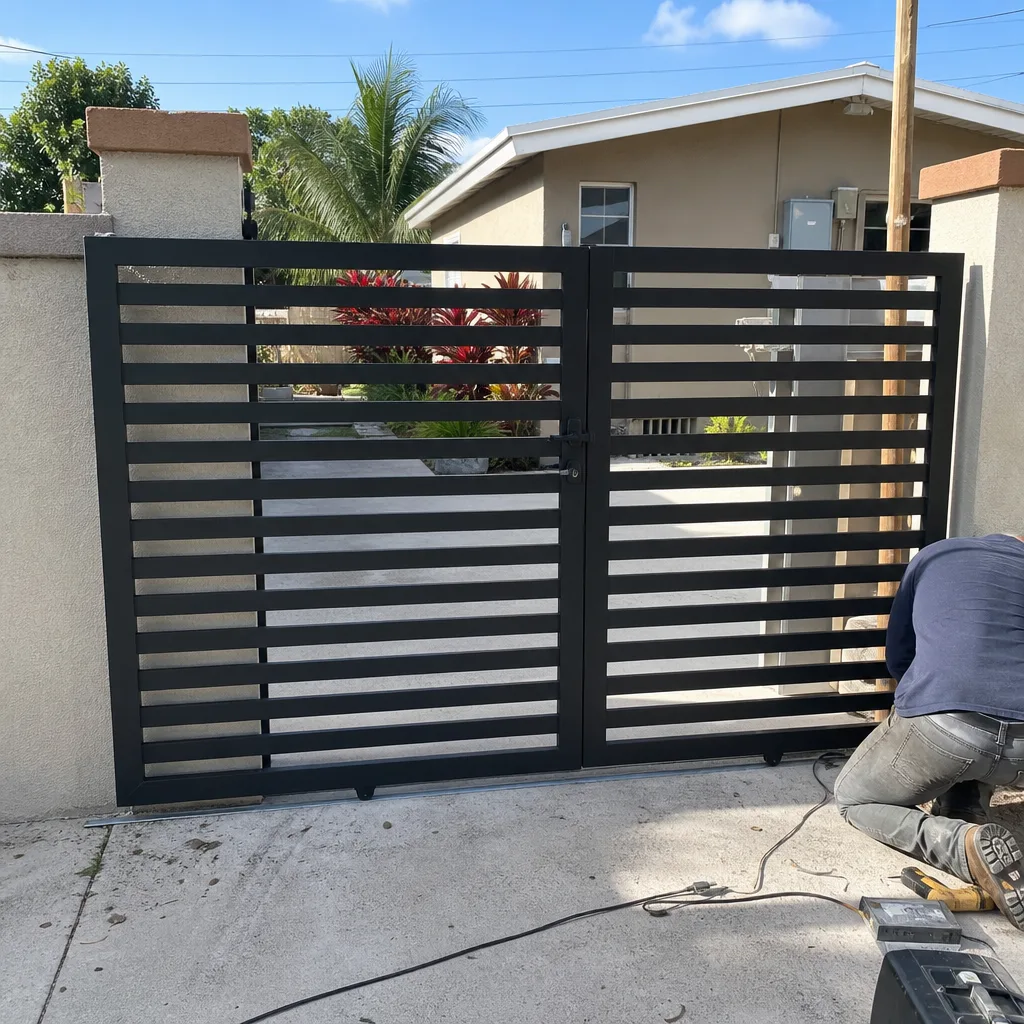
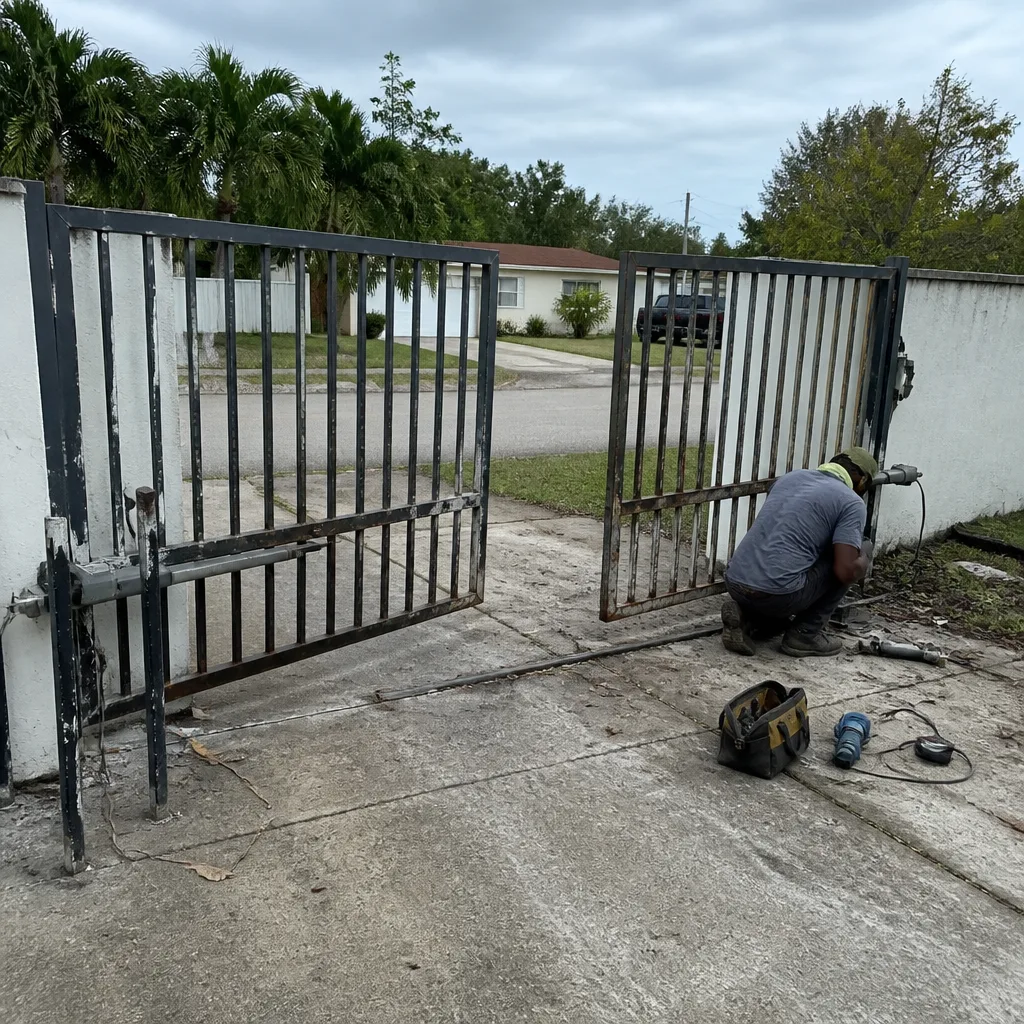
See the difference
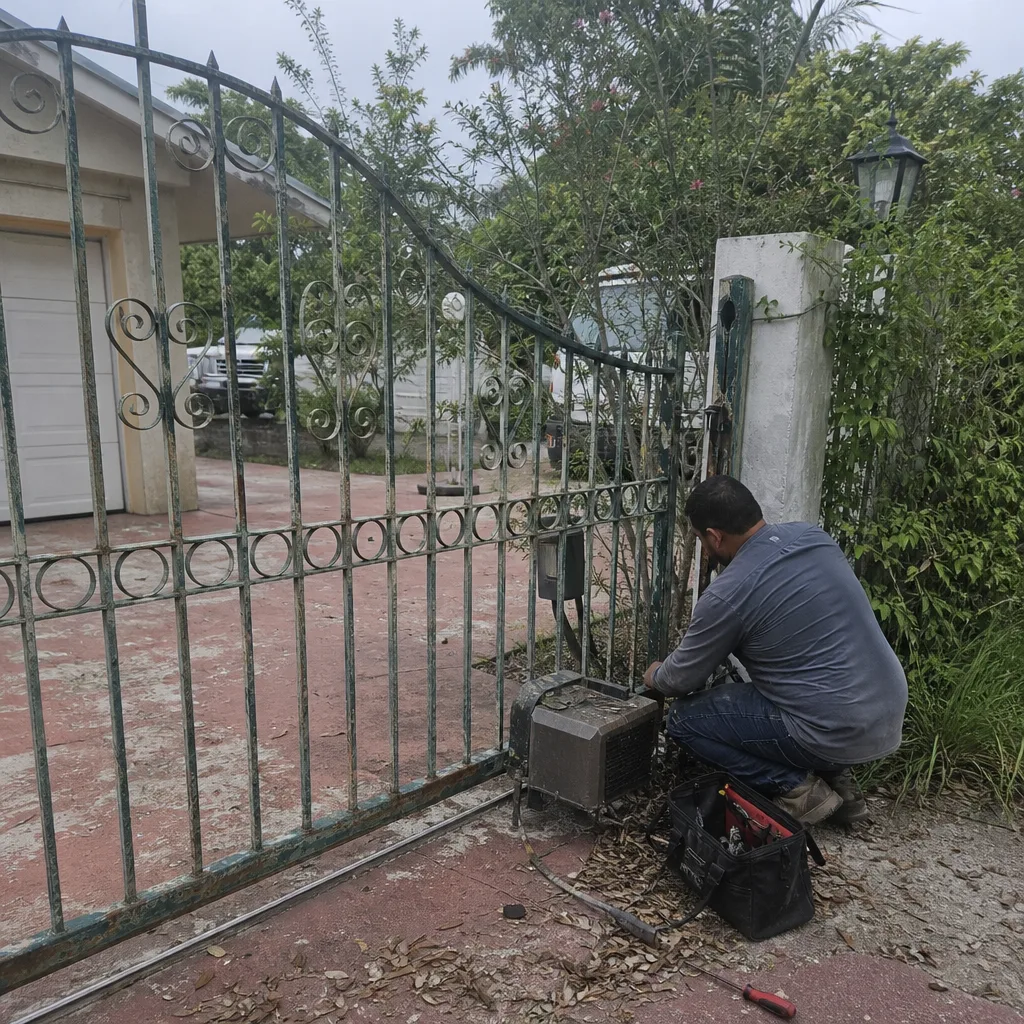 Before
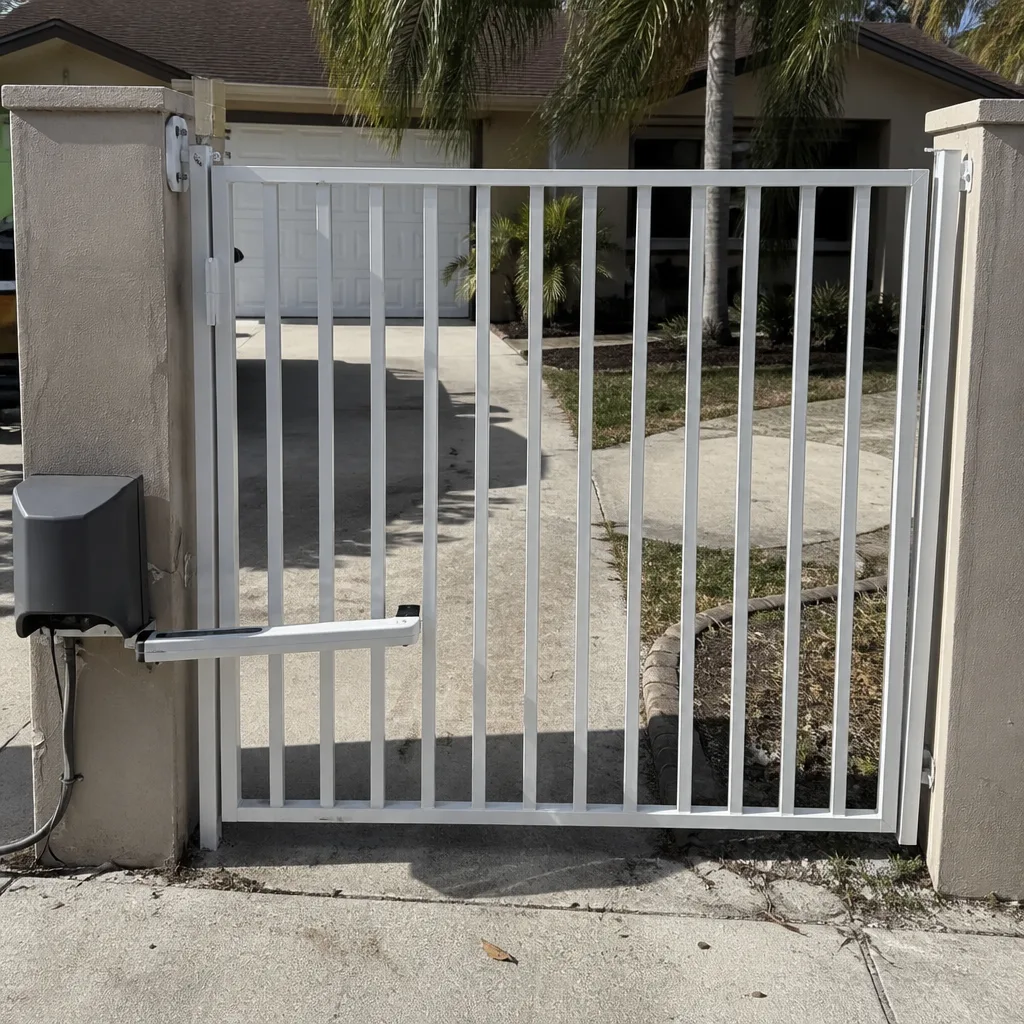 After
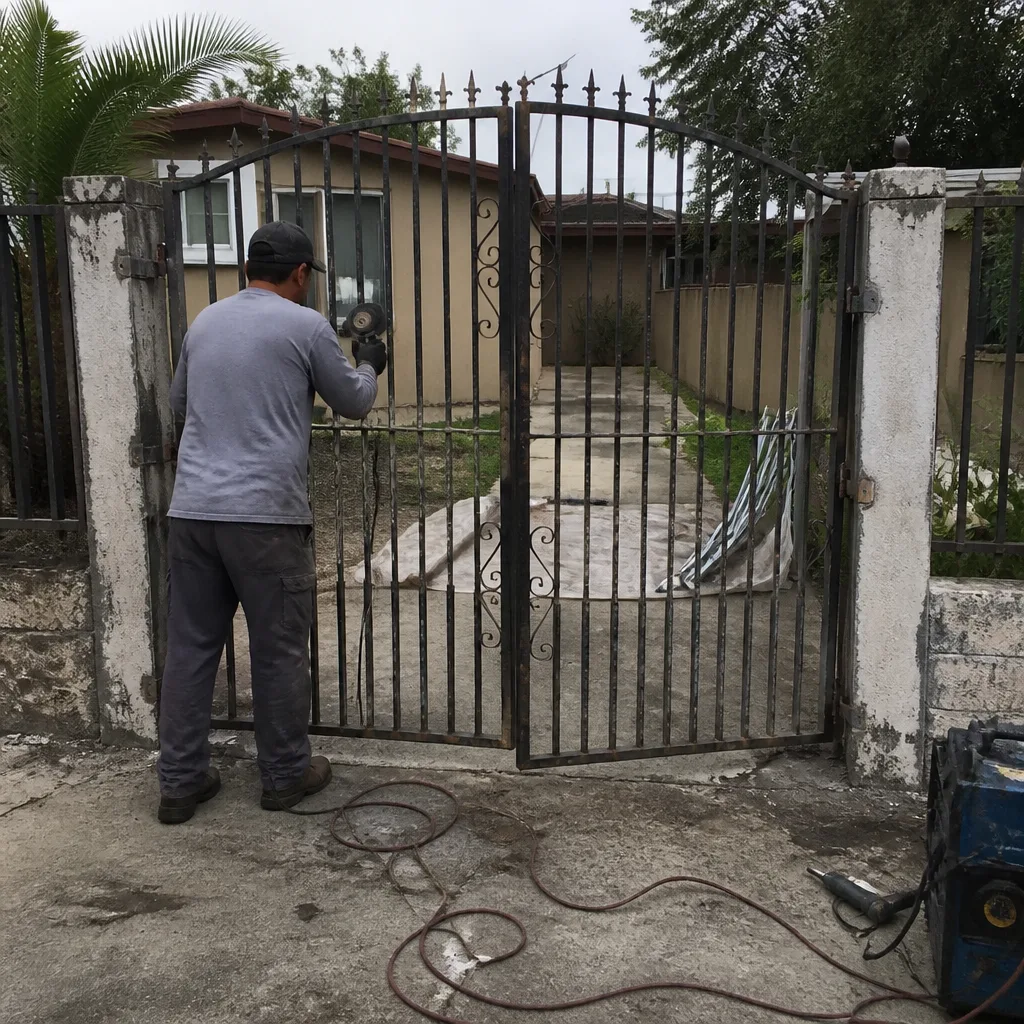 Before
 After
 Before
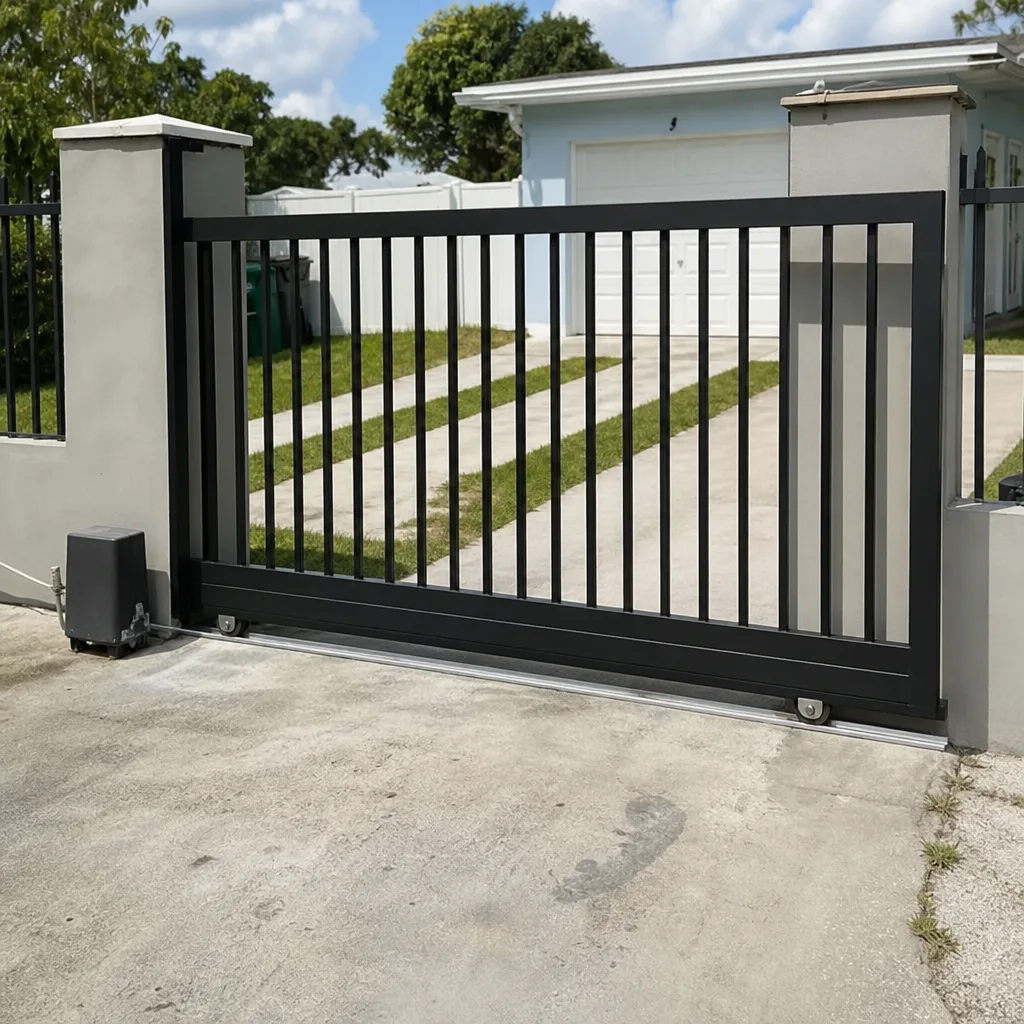 After
When to Call a Professional
Call a professional any time you see the enclosure seal compromised, hear a grinding or chattering sound the gate didn’t make last week, or smell burning electronics from the operator. If the gate moves on its own, reverses randomly, or won’t stop at the limits, that’s a control issue, not a mechanical one. If you have a swing gate with an actuator and you see hydraulic fluid around the arm or on the ground, stop running the gate until it’s inspected. For electrical diagnostics, especially anything involving the board, loop wiring, or access system integration, the risk of further damage or safety system compromise is too high for trial-and-error. Miami Gardens Gate Repair offers free estimates in Miami Gardens. Call (855) 382-0732 and describe what your gate is doing. We can usually tell you over the phone whether it sounds mechanical, electrical, or uncertain, and what the next step is.
Frequently Asked Questions
Most single-component gate repairs in Miami Gardens run between $150 and $450 depending on the part and labor involved. A full operator replacement typically ranges from $700 to $1,800 depending on brand, swing versus slide configuration, and whether the control board and safety systems need to be upgraded at the same time. The exact quote is always agreed with you before any work starts. Call (855) 382-0732 for a free estimate specific to your gate.
In many cases, yes. Simple failures like a seized roller, a blown capacitor, or a misaligned photo-eye can often be diagnosed and repaired on the first visit. More complex issues, like a failed control board that needs to be ordered or a hydraulic actuator that needs bench repair, may take a day or two depending on parts availability. We always explain the timeline before starting work. Call (855) 382-0732 to describe the symptom and we’ll give you a realistic expectation.
Thunderstorms in Miami Gardens cause two distinct damage paths: lightning-induced voltage spikes that degrade control board components and moisture intrusion that shorts low-voltage wiring. The failure often doesn’t appear immediately; a board can be damaged during a storm and fail days or weeks later. If your gate stopped working after a storm, the first step is a visual check for moisture or salt deposits inside the enclosure. If you see any, leave the cover open to dry and call us to evaluate the board before running the gate again.
Three factors decide it: the operator’s age relative to Miami Gardens’s accelerated lifespan (see the table above), the extent of corrosion on the board and harness, and the status of the safety systems. If the operator is past its local lifespan and shows corrosion, a major repair is usually not the smart spend. If it’s mid-life and the board is clean, a component repair can buy several more years. We never push replacement when repair makes sense. Call (855) 382-0732 and we’ll give you an honest assessment.
We work on every major gate operator brand sold in the U.S. market, including LiftMaster, FAAC, BFT, Linear, Viking, Ghost Controls, DoorKing, Elite, and Mighty Mule. If you have an older or obscure brand, call us anyway; brand familiarity across nine major manufacturers means we can often identify the failure pattern in a brand we see less often. The brand-specific knowledge matters because each operator family has its own weak points and diagnostic signatures.
If you have an electric or automatic gate in Miami Gardens, yes. The frequency of lightning activity here means surge protection isn’t optional; it’s preventive maintenance. Proper surge protection for a gate system includes protection on the incoming power line and isolation on the low-voltage loop and peripheral circuits. Different operator brands have different levels of onboard surge immunity. We can test your existing protection and recommend what’s appropriate for your specific operator.
The Bottom Line
Miami Gardens gates fail differently than gates anywhere else in the country. Salt-laden humidity corrodes boards and harnesses. Daily thunderstorms degrade electronic components even when they don’t cause immediate failure. Hurricane season loads mechanical systems beyond their design limits. The homeowners who avoid the worst outcomes are the ones who inspect regularly, act on early warning signs, and understand the boundary between maintenance and repair. Use this guide as your reference. When the problem is beyond what you’re comfortable handling, call us. We know Miami Gardens, we know gates, and we know your gate brand, because we work on all of them.
If your gate is acting up, call (855) 382-0732 for a free estimate. We’ll diagnose it right, tell you straight whether it’s a repair or a replacement, and quote the price before any work starts. For more on our full service range, see our overview of Miami Gardens Gate Repair home and our Gate Repair in Miami Gardens page.
Written by the team at Miami Gardens Gate Repair, serving Miami Gardens since 2012.