
Last updated October 30, 2026
 Wrought iron
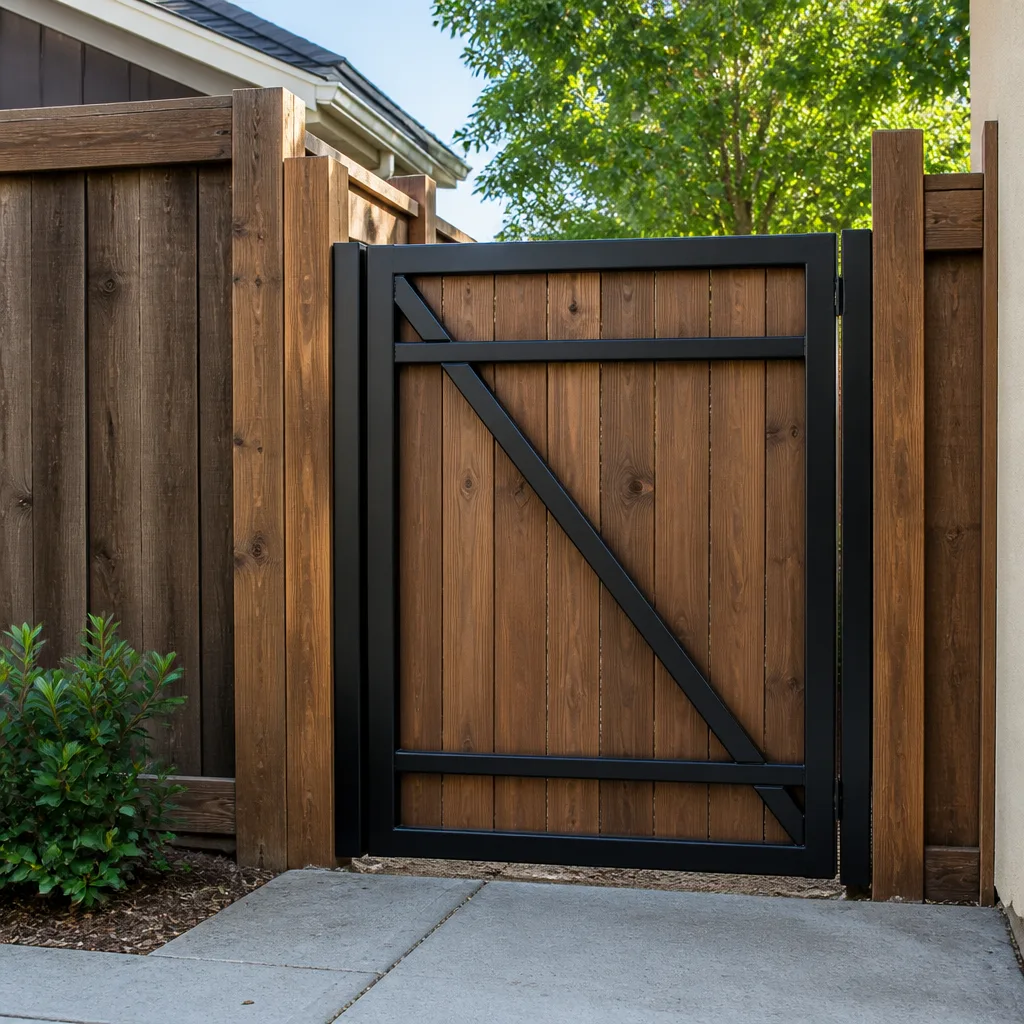 Wood & steel frame
 Farm & ranch
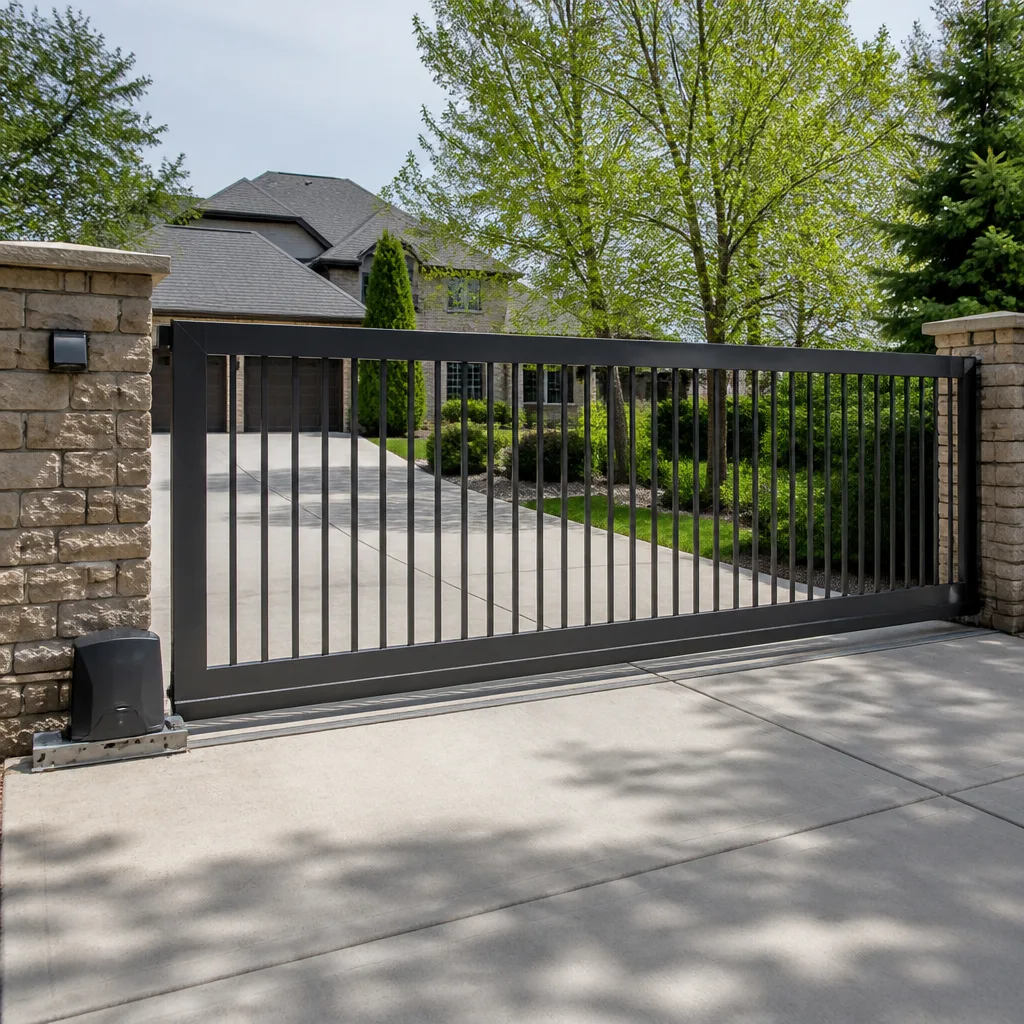 Sliding driveway gates
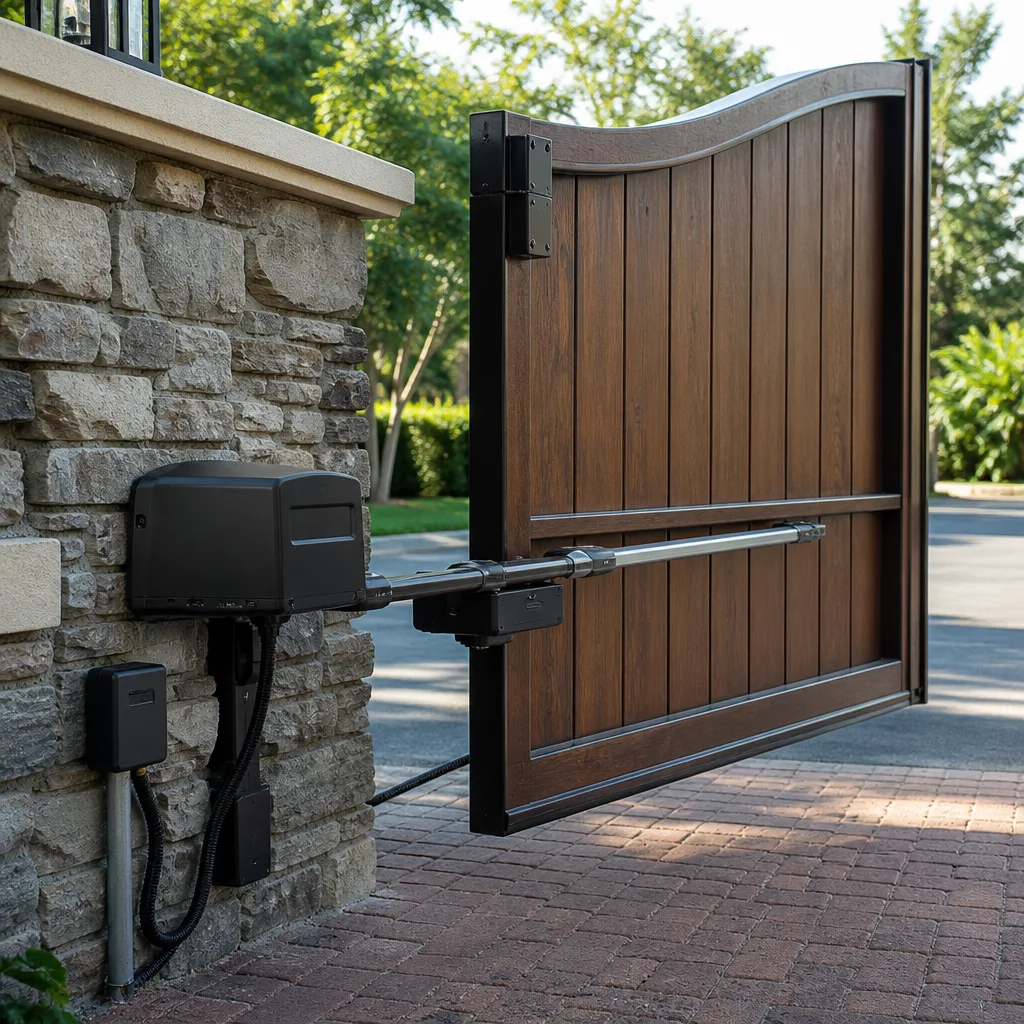 LiftMaster operators
Free on-site gate assessment - hinges, posts, and your LiftMaster or Nice gate operator checked before anything is quoted
The assessment is free and the quote is the invoice.
Get your free estimateDIY vs Professional Gate Repair: The Miami Gardens Homeowner’s Decision Guide
A gate operator stores enough capacitor charge to stop your heart after it’s been unplugged. That’s the conversation no YouTube tutorial has before the “easy repair” demo starts. When your gate stops working in Miami Gardens, the real question isn’t whether you’re handy enough to fix it yourself or if you need Gate Repair services. The question is which layer of the system failed, and whether that layer can kill you or cost you five figures if you get it wrong. This guide draws that line clearly, so you can make the call with confidence: grab a wrench, or grab a phone.
Quick Answer
DIY gate repair makes sense for mechanical issues you can see: loose hinges, dry bearings, misaligned tracks, dead remote batteries. It makes no sense for anything involving operator wiring, control boards, capacitor discharge, entrapment sensors, or load-bearing springs under tension. In Miami Gardens, where salt air accelerates corrosion and afternoon storms soak components, the safe DIY zone is smaller than most homeowners assume.
Styles & brands we work with
Table of Contents
- Mechanical vs Electrical: The Line That Decides Everything
- What’s Genuinely DIY-Safe: The Three-Tier Model
- The Danger Zone: What Requires a Licensed Technician
- UL 325 and the Legal Liability You Didn’t Know You Had
- The Parts Problem: Why You Can’t Just Order It on eBay
- Florida Licensing Law and DIY Electrical Work
- The Hybrid Approach: Save Money Without Touching the Wires
- Miami Gardens-Specific Factors That Change the Math
Mechanical vs Electrical: The Line That Decides Everything
Gate systems have two distinct halves, and the DIY conversation changes completely depending on which one failed. The mechanical half includes hinges, wheels, tracks, chains, belt tension, and the physical gate structure itself. The electrical half includes the operator motor, control board, capacitors, loop detectors, photocells, safety edges, keypads, and the low-voltage wiring that connects everything.
We’ve seen homeowners in Miami Gardens confidently rebuild a gate hinge assembly while their gate was still wired to a live operator. That’s the mistake that turns a $200 mechanical fix into a $2,000 control board replacement. The mechanical side forgives mistakes. The electrical side doesn’t. Before you touch anything, identify which half you’re dealing with.
A swing gate that sags on its hinge is a mechanical problem. A swing gate that opens halfway and reverses is likely a force-sensitivity setting or an obstruction sensor issue, both electrical. A sliding gate that grinds along its track is mechanical. A sliding gate that won’t respond to the remote at all is electrical, regardless of how clean the track looks. If your gate operator keeps the gate from opening, the problem could be motor, board, or wiring. Misdiagnosing mechanical for electrical (or the reverse) wastes time and often makes the original problem worse.
What’s Genuinely DIY-Safe: The Three-Tier Model
We use a three-tier model when talking to Miami Gardens homeowners about what they can safely handle themselves. Tier one is always safe. Tier two is conditionally safe. Tier three is never safe without factory training and proper equipment. Here’s how it breaks down.
Tier One: Always DIY-Safe
These tasks require no electrical contact and minimal mechanical risk. A competent homeowner with basic tools can do them in under an hour. If you can see it move and you can touch it while the power is off, it’s probably tier one.
- Lubrication: Hinges, rollers, and chains need lubrication every 3-6 months in Miami Gardens. Salt air dries out factory grease faster than inland climates. Use a silicone-based lubricant, never WD-40, which strips protective coatings.
- Visual inspection: Walk the gate while it’s disengaged from the operator. Look for rust, bent components, loose bolts, and track obstructions. Document what you find with your phone camera.
- Remote reprogramming: Losing a remote or buying a spare is a common fix. Most LiftMaster, Mighty Mule, and Ghost Controls remotes have a simple learning process that takes two minutes and requires no wiring.
- Track cleaning: Sliding gates accumulate sand, leaves, and debris in Miami Gardens. Cleaning the track and ensuring it’s clear is basic maintenance, not repair.
- Battery replacement: Remote batteries and keypad batteries are the most common “gate won’t open” culprits. Replace these before calling anyone.
Tier Two: Conditionally DIY-Safe
These tasks are mechanical but involve components under load or components that affect gate alignment. Safe for a homeowner who’s comfortable with tools and understands how the gate’s weight distributes across hinges and wheels. Unsafe for someone who’s never held a torque wrench.
- Hinge adjustment: A sagging gate can often be corrected by adjusting hinge bolts. But the gate must be properly supported before any hinge bolt is loosened. A gate that falls on you weighs hundreds of pounds.
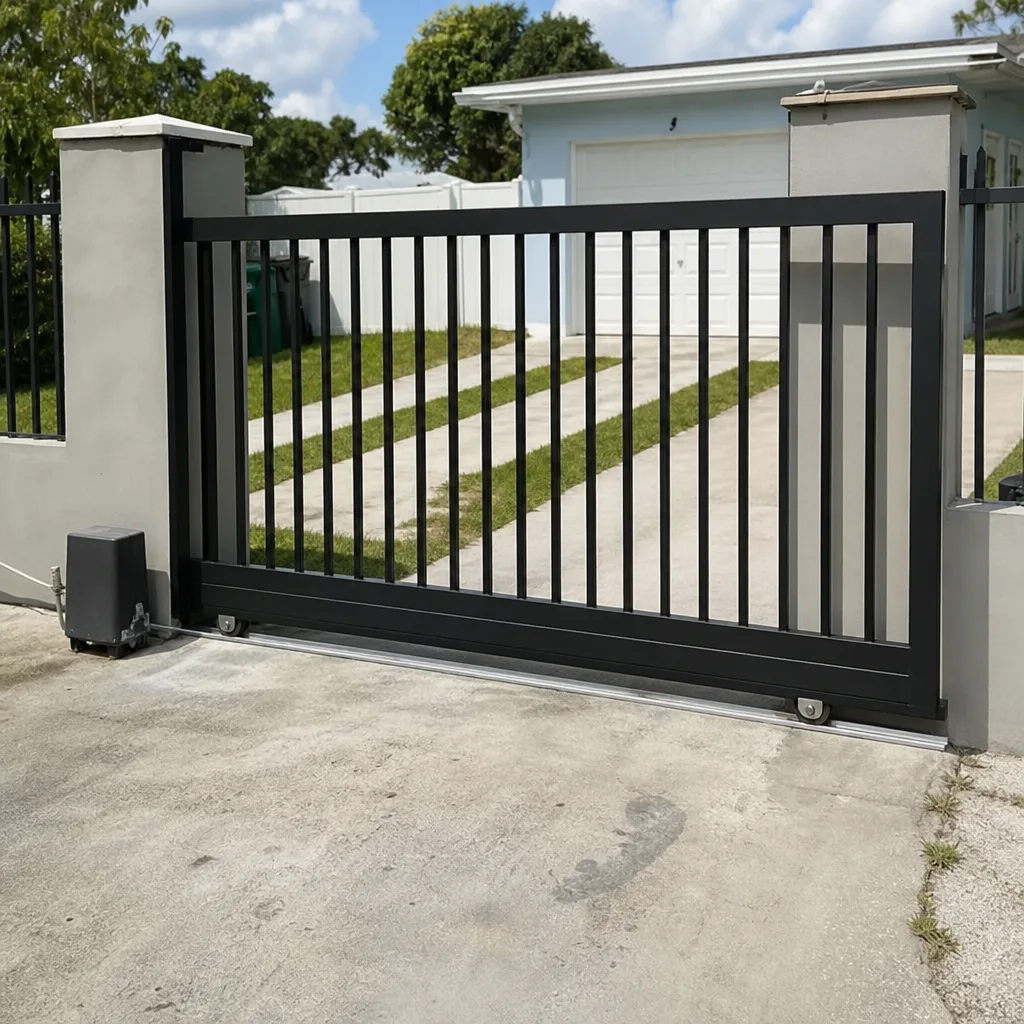
- Wheel replacement on sliding gates: The gate must be jacked and blocked. Never work under a raised gate, even for a “quick” wheel swap.
- Limit switch adjustment: Some older operators have mechanical limit switches that control how far the gate travels. Adjusting these changes where the gate stops. If adjusted wrong, the gate can overtravel and damage the operator or the gate itself.
- Sensor cleaning: Photocells at the gate’s base get dirty and misaligned. Cleaning the lenses and straightening the housings is usually safe. The moment you need to touch wiring, this moves to tier three.
Tier Three: Never DIY
This is the line. Crossing it is how people get hurt and how gate systems get destroyed. Tier three includes anything involving capacitor charge, control board replacement, operator motor work, loop detector installation, or entrapment sensor wiring. These tasks require not just technical knowledge but specific safety procedures for discharging stored energy and verifying proper entrapment protection.
The capacitor inside a gate operator holds a lethal charge even after the unit is unplugged. Touch the wrong terminal and the result isn’t a shock, it’s cardiac arrest. That’s not scare language. That’s physics. In our experience, the homeowners who DIY a control board swap are the same homeowners who call us a week later because the replacement board fried on installation or the gate won’t respond the way it should. The board wasn’t the problem the first time, but now it is.
The Danger Zone: What Requires a Licensed Technician
If your gate problem lives in any of these areas, the DIY conversation is over. Call someone who works on gates daily, not a generalist who’ll learn on your property.
Operator Wiring and Control Boards
Control boards are the brain of the gate system. They receive input from remotes, keypads, loop detectors, and safety sensors, then send commands to the motor. Replacing a board means matching voltage requirements, processor compatibility, and I/O configuration to the existing operator. A board from a similar-looking model can fail immediately or, worse, fail intermittently, leaving your gate unreliable when you need it most.
We see Miami Gardens homeowners buy FAAC boards for BFT operators because the connectors look the same. They are not the same. The board learns the operator’s motor characteristics during first power-up. Wrong board, wrong motor profile, fried board. Sometimes the motor goes with it.
Capacitor Discharge and Motor Work
Capacitors store energy to give the motor a starting boost. That energy remains after disconnection. Proper discharge requires a resistor and a procedure, not just waiting ten minutes. Motor replacement involves mechanical alignment, torque specifications, and electrical integration with the control board.
Loop Detector Installation
Loop detectors are coils of wire buried in the driveway that detect vehicles and trigger the gate to open. Installation requires cutting the driveway, laying the loop with specific winding counts and depth tolerances, sealing it, and tuning the detector sensitivity. Get the winding count wrong and the detector won’t sense a small car. Miss the depth and it won’t sense anything. This is not a weekend project.
Entrapment Sensor Setup
Photo beams, safety edges, and obstruction sensors all require specific mounting heights, alignment tolerances, and wiring to the control board’s safety input. A sensor wired to the wrong terminal bypasses the safety system entirely. The gate opens and closes, and you’ll never know the safety is off until someone gets hurt.
UL 325 and the Legal Liability You Didn’t Know You Had
UL 325 is the national safety standard for automatic gate operators. It exists because people have died. Gates have crushed children, pinned adults, and dragged pets. The standard mandates specific entrapment protection: photo eyes, contact sensors, or both, depending on the operator type and installation context.
When you repair your own gate and change the way the operator behaves, you take legal responsibility for UL 325 compliance. If your DIY repair bypasses or misaligns an entrapment sensor and someone gets hurt, your homeowner’s insurance may deny the claim. More importantly, you’ll live with the consequence of a safety system you disabled without knowing it.
Here’s the scenario we see repeat: a homeowner adjusts the gate’s close force to fix a sticky hinge. The gate was binding because the hinge needs replacement, not because the force setting is low. Now the operator pushes through the binding with higher force. A child squeezes through the gap before the gate fully closes. The gate doesn’t detect the child. The force setting was high enough to crush. That’s a UL 325 violation created by a YouTube fix.
Professional technicians are trained to verify entrapment protection after every repair. They test photo beam alignment, safety edge functionality, and force sensitivity using standardized procedures. Every time. Not just when something seems off.
The Parts Problem: Why You Can’t Just Order It on eBay
Search for a LiftMaster control board on eBay and you’ll find dozens of listings. Some are legitimate take-offs from decommissioned gates. Others are counterfeit, rebuilt, or damaged. Here’s what you won’t find in the listing: whether the board’s firmware matches your operator’s motor revision.
Gate operator manufacturers release firmware updates to fix bugs, improve safety, and support new accessories. A board with outdated firmware in a newer operator can cause erratic behavior. A board with firmware from a different motor revision can fail entirely. Factory-authorized dealers receive the correct parts with the correct firmware for the operators they service. That’s why operators like FAAC, BFT, LiftMaster, and Mighty Mule restrict certain components to authorized distributors.
- Warranty void: Most manufacturers void the operator warranty when non-factory parts are installed by non-authorized personnel. Mighty Mule’s warranty specifically excludes damage from unauthorized repairs.
- Compatibility failures: A control board for a LiftMaster CSL24U is not the same as one for an LA500. They look identical. They are not.
- Counterfeit electronics: Rebuilt boards with replaced capacitors and reflowed solder joints look fine and fail within months. Quality control on eBay is nonexistent.
- No technical support: Buy a board from a dealer and you get manufacturer support. Buy it from a stranger in Ohio and you get silence when it doesn’t work.
For Miami Gardens homeowners, the parts sourcing problem compounds with climate. Salt air corrodes connections, and a board that sat in a humid warehouse for two years may already be compromised when you install it. Professional parts come through channels that control storage conditions.
Florida Licensing Law and DIY Electrical Work
Florida statute requires a license for electrical contracting work. Gate operators are low-voltage systems, typically 24V DC, which falls under a different category than household 120V AC wiring. But the line is not as clear as homeowners assume. Florida’s low-voltage licensing framework sets parameters for what unlicensed individuals can and cannot charge for. Here’s what matters for the DIY conversation.
You can work on your own gate. Florida law allows homeowners to perform work on their own property without a contractor’s license. That’s not the question. The question is what happens when your work fails. If you sell the home and the new owner’s gate malfunctions due to your repair, you may face liability. If your repair causes an injury, the absence of a licensed professional’s involvement becomes central to any legal claim.
For rental properties, the math changes. Property owners who perform electrical work on a rental unit’s gate system, or who hire an unlicensed handyman to do it, operate in legally gray territory. Tenants have rights. Insurance policies have exclusions. A licensed gate technician carries the training, documentation, and insurance that protects a property owner from those scenarios.
We’re not lawyers and this is not legal advice. But in our experience working on gates across Miami Gardens, the homeowners who understand the liability environment make different decisions than the ones who only compare parts prices.
The Hybrid Approach: Save Money Without Touching the Wires
The do-everything-or-call-a-pro binary is false. There’s a third path. Homeowners in Miami Gardens can reduce billable diagnostic time by doing the safe documentation themselves before the technician arrives. We’ll tell you exactly what saves you money and what wastes your time.
- Record the exact symptom: “Gate won’t open” helps. “Gate opens two feet, stops, and beeps three times” is diagnostic gold. Write down what you see and hear. Video it on your phone.
- Note the operator brand and model: The label is on the operator housing. LiftMaster, FAAC, BFT, Mighty Mule, Ghost Controls, whatever it is. Model numbers tell us what board, motor, and accessories we’re walking into.
- Check the obvious tier-one items first: Remote battery, keypad battery, breaker tripped, track obstruction. The technician who finds a dead battery is billing you for a service call you could have avoided.
- Document when it started: Did the gate fail gradually (getting slower, grinding more) or suddenly (worked this morning, dead this afternoon)? Sudden failures are often electrical. Gradual failures are often mechanical wear.
- Disengage the operator and test manual operation: Most operators have a manual release. If the gate moves freely by hand, the problem is electrical. If it binds manually, the problem is mechanical. This single test splits the diagnostic tree in half and saves real money.
Do these five steps before you call and you’ll cut diagnostic time meaningfully. Miami Gardens Gate Repair home explains our full repair approach, including how we handle brand-specific diagnostics across nine major manufacturers.
Miami Gardens-Specific Factors That Change the Math
Miami Gardens has a climate that accelerates gate failure and punishes casual repairs. If you’ve lived here through one wet season, you know what we mean. The humidity alone causes corrosion that inland homeowners never see. The afternoon storms flood gate tracks and saturate junction boxes. The salt air off the Atlantic travels further inland than most people realize and eats through unprotected metal.
What does this mean for the DIY conversation? Two things. First, the deterioration happens faster, so the stakes of a wrong repair are higher. A silicone seal applied incorrectly lets moisture into a control board housing. That moisture condenses, shorts the board, and you’re replacing a $400 part because a $5 tube of sealant was applied wrong. Second, the corrosion expands the danger zone. A gate hinge that looks fine and has a rust line underneath is not fine. It’s load-bearing metal compromised by oxidation. When it fails, it fails suddenly.
The Miami Gardens gate landscape is also brand-diverse. Stroll through any neighborhood near the Hard Rock Stadium and you’ll see Mighty Mule kits on residential swing gates, LiftMaster operators on sliding gates, FAAC on older estate properties, and BFT on newer installations. This matters because no single YouTube tutorial covers all of them. The repair that works on a Mighty Mule won’t apply to a LiftMaster. The control board that works in a FAAC won’t work in a BFT.
We work on all of them, side by side, which is why we recognize what you have before the gate is even fully open. That brand fluency changes the diagnostic speed and the accuracy of the first repair attempt. You can read a forum thread about a similar symptom on a different brand, but that’s guesswork. We know whether your symptom matches a known failure pattern for your specific operator.
Common Mistakes to Avoid
- Replacing the board before testing the power supply. A control board that gets no power looks dead. The transformer, breaker, or wiring may be the actual failure. When we see a homeowner replace a board that was fine, and the replacement also won’t power up, the conversation turns to what they should have tested first.
- Adjusting force settings to fix a mechanical bind. Raising force sensitivity so the gate pushes through resistance is the most dangerous DIY fix in our industry. It masks the real problem and creates an entrapment hazard. If the gate binds, find the bind. Don’t force it.
- Using WD-40 on gate hardware. WD-40 is a solvent, not a lubricant. It cleans but doesn’t protect. It breaks down existing grease and leaves metal vulnerable to Miami Gardens humidity. Use silicone-based lubricants only.
- Buying a universal remote without checking compatibility. Not all universal remotes work with all operator brands. Mighty Mule uses a specific frequency. LiftMaster uses rolling codes. A universal remote that doesn’t work is $40 wasted and another trip to the store.
- Ignoring the small warning signs. A gate that runs slightly slower in May becomes a gate that fails entirely in August. The slow buildup of resistance over weeks is the earliest indicator of bearing wear, motor strain, or voltage drop. Catch it early and the repair is simple.
- Working on an operator without disconnecting power. Unplugging the operator is step one, always. But unplugging doesn’t discharge the capacitor. Treat every electrical component as live until proven otherwise. You can’t see stored energy. It can still stop your heart.
- Assuming a stuck gate is a simple fix. “It’s probably just the sensor.” That’s the phrase we hear before half our service calls in Miami Gardens, and it’s wrong more often than it’s right. The gate that seems like a simple fix is often the one with a cascade failure across multiple components.
See the difference
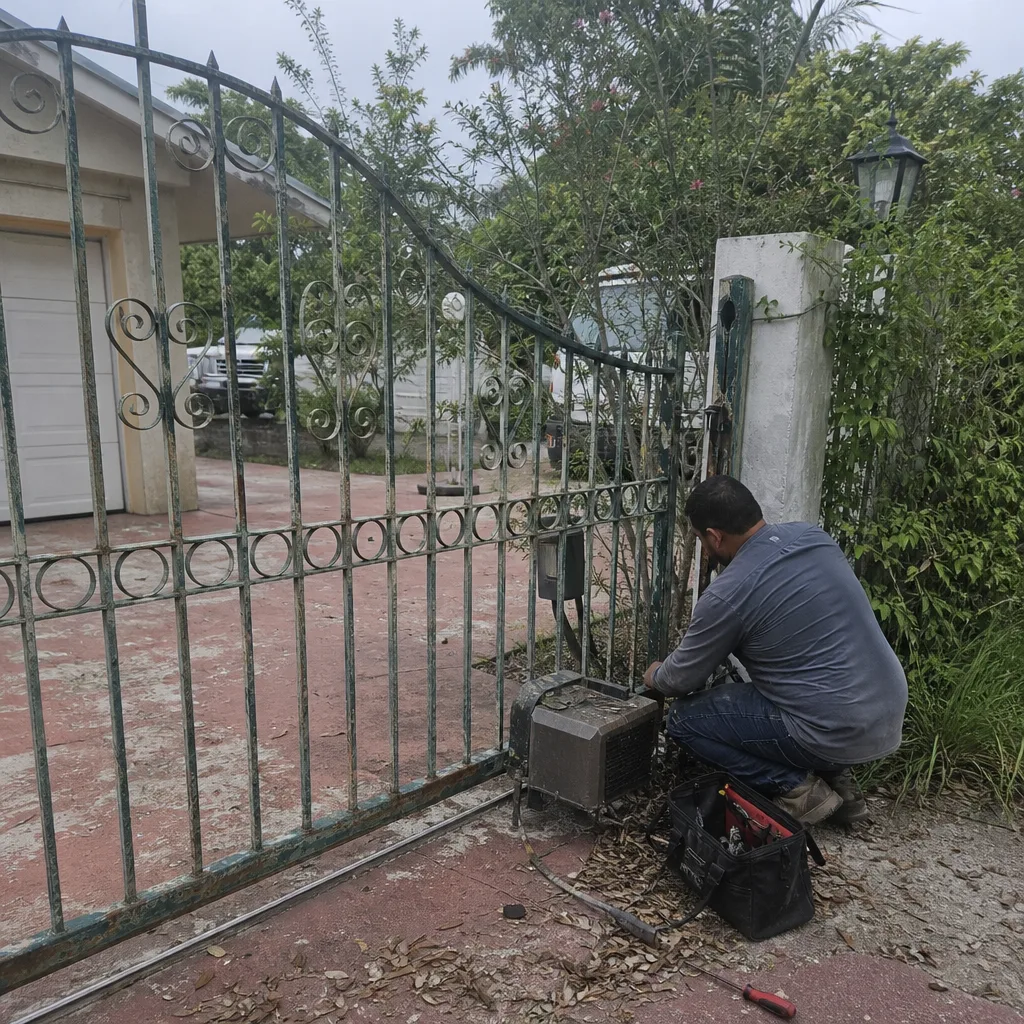 Before
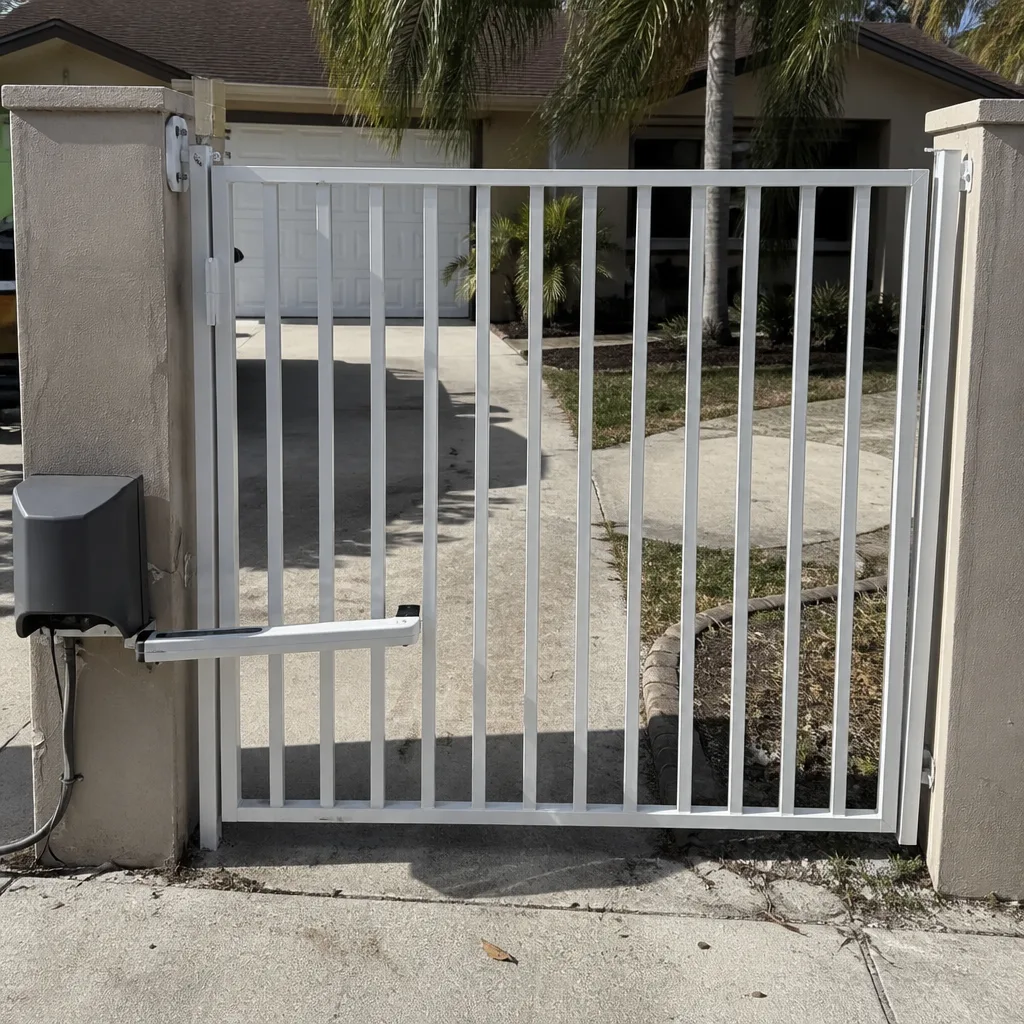 After
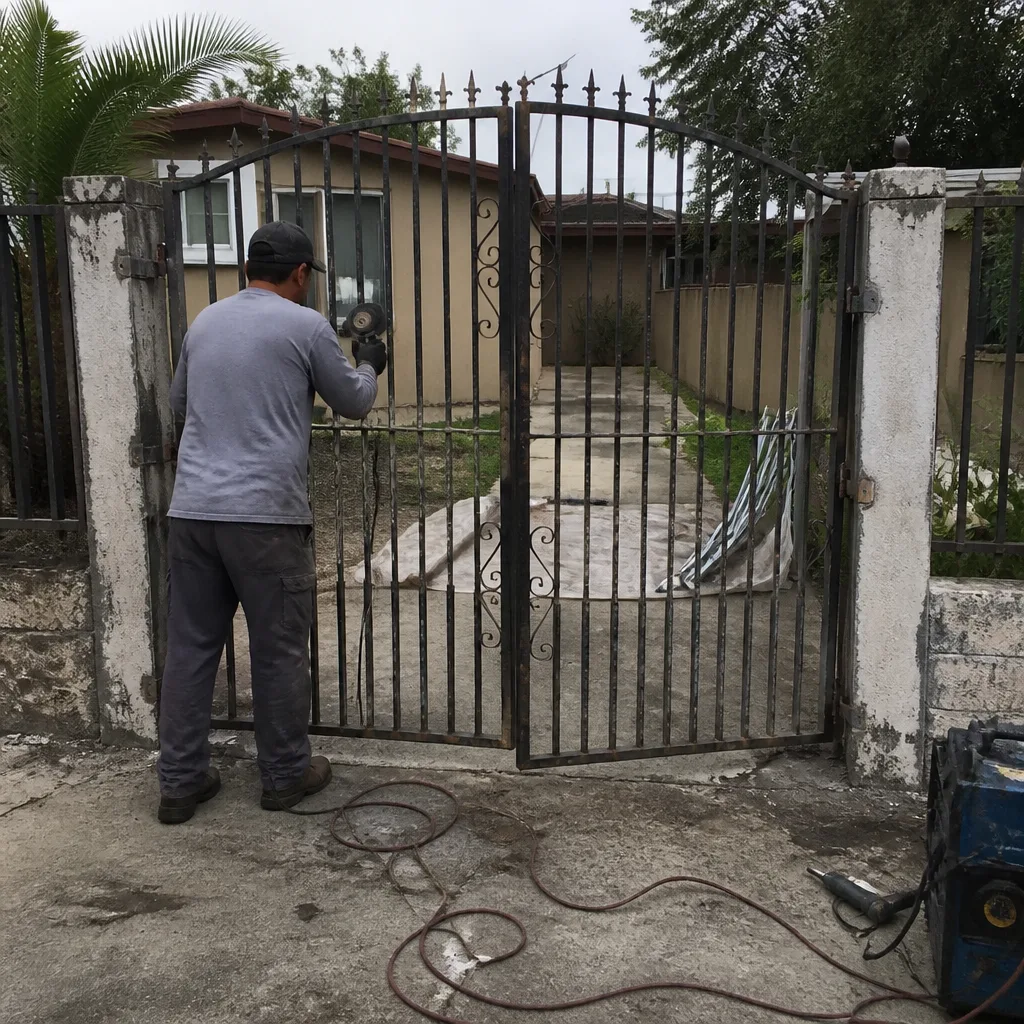 Before
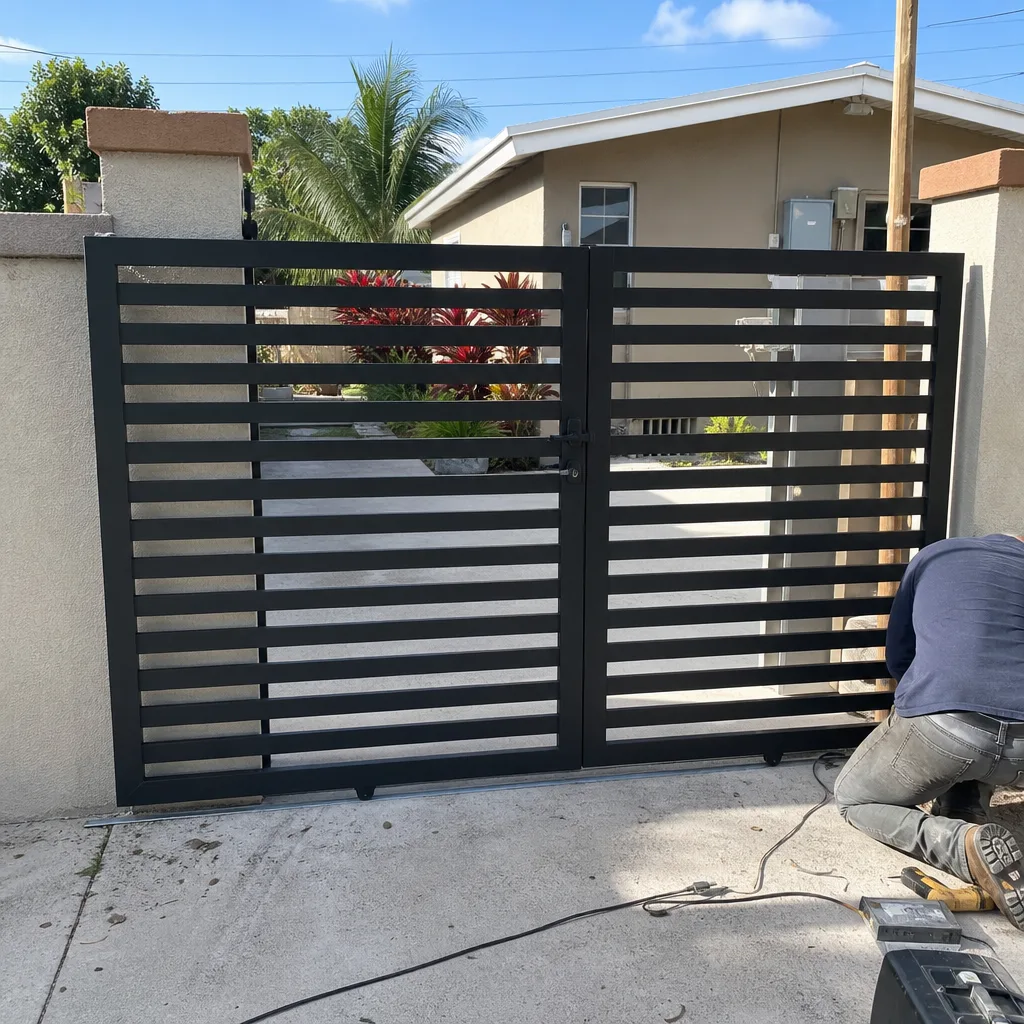 After
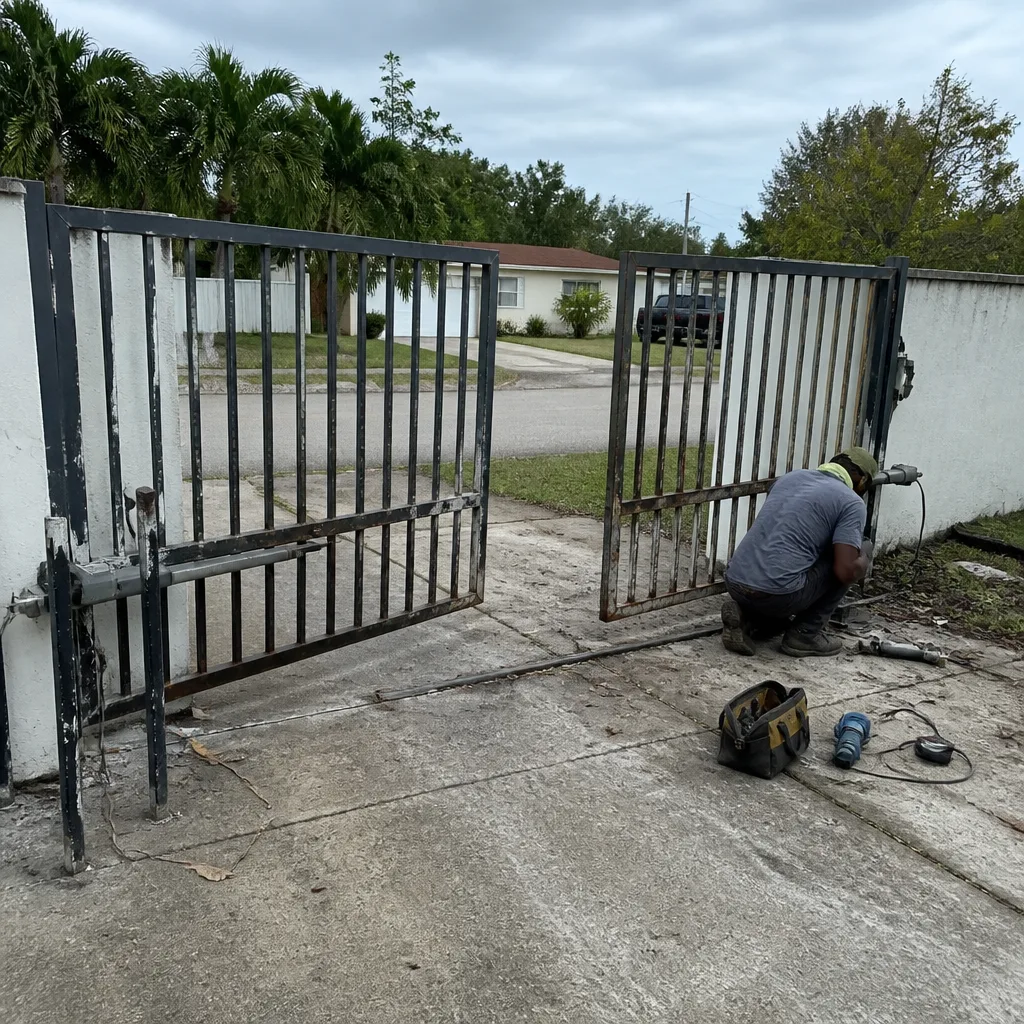 Before
 After
When to Call a Professional
Call a professional the moment your gate problem involves operator wiring, control boards, capacitor discharge, motor replacement, loop detectors, entrapment sensors, or any repair that requires the operator to be opened. Call a professional when the gate is your primary security barrier and leaving it broken overnight is not acceptable, or consult our Gate Repair Emergency Preparedness Guide for Miami Gardens Homes to plan ahead. Call a professional when you’ve completed the five diagnostic steps above and still don’t know what’s wrong. And call a professional when your gate is a brand you don’t recognize and the repair manual isn’t available.
Gate Repair in Miami Gardens covers the full range of mechanical and electrical failures, from a single broken hinge to a complete operator rebuild. For electrical and automation faults specifically, Electric Gate Repair in Miami Gardens details our diagnostic approach to boards, motors, sensors, and access systems. If your gate is beyond repair, Gate Installation in Miami Gardens explains our full-installation process for single and dual operators. Miami Gardens Gate Repair offers free estimates in Miami Gardens, call (855) 382-0732.
Frequently Asked Questions
Gate repair in Miami Gardens typically runs $150 to $600 for mechanical issues like hinge replacement, wheel swaps, or track alignment. For detailed pricing on specific repairs, see our Gate Repair Cost Breakdown: The Miami Gardens Homeowner’s Reference for 2026. Electrical repairs including control board replacement, motor work, or sensor rewiring run $300 to $1,200 depending on the operator brand and parts required. Call (855) 382-0732 for an exact quote, estimates are free.
Yes. The capacitor inside the operator stores electrical charge specifically designed to deliver a powerful motor-starting surge. That charge persists after the unit is unplugged. Touching the wrong two terminals simultaneously can cause cardiac arrest. This is not theoretical, it’s the reason professional technicians use discharge procedures before touching control board components.
Corrosion-related mechanical failure is the most common gate problem we see in Miami Gardens. Gate hinges, track rollers, and chain components rust faster here than in drier climates. The second most common is control board failure caused by moisture intrusion into operator housings. Both are preventable with regular maintenance and proper sealing.
It depends on the operator brand and the failure point. A Mighty Mule residential operator with a failed control board is often worth repairing because boards are available and the units are simple. A 15-year-old FAAC with a failed motor and a corroded housing may be better replaced. We evaluate repair vs replacement honestly and tell you which makes sense for your specific operator.
Minor repairs and maintenance generally do not require a permit in Miami Gardens. Full gate installation or significant structural modification may. For electrical work on your own property, a homeowner can legally perform the work. For rental properties or commercial gates, the licensing requirements change. Always check with Miami Gardens building department before starting a major project.
Check the photo eyes first. They’re at the base of the gate on opposite sides of the opening. If one is dirty, misaligned, or obstructed, the operator thinks something is in the way and reverses or stops. Clean both lenses, ensure they point at each other, and test again. If the gate still won’t close, the force setting or limit setting may need adjustment, which is a job for a professional. Call (855) 382-0732 if cleaning the sensors doesn’t fix it.
The Bottom Line
The DIY vs professional gate repair decision comes down to which layer of the system failed. Mechanical, visible, non-electrical problems are fair game for a competent homeowner who respects the weight of the gate and the load on its components. Electrical, sensor-related, or control board problems are not. The capacitor charge alone is reason enough to step away. Add UL 325 liability, warranty voiding, counterfeit parts, and Miami Gardens salt air, and the math resolves clearly. If you can see it and it’s mechanical, handle it. If it involves wires, boards, sensors, or motors, call (855) 382-0732. You’ll get a straight answer, a free estimate, and a technician who knows your gate brand because we work on all of them.
Written by the team at Miami Gardens Gate Repair, serving Miami Gardens since 2012.