
Last updated October 30, 2026
 Wrought iron
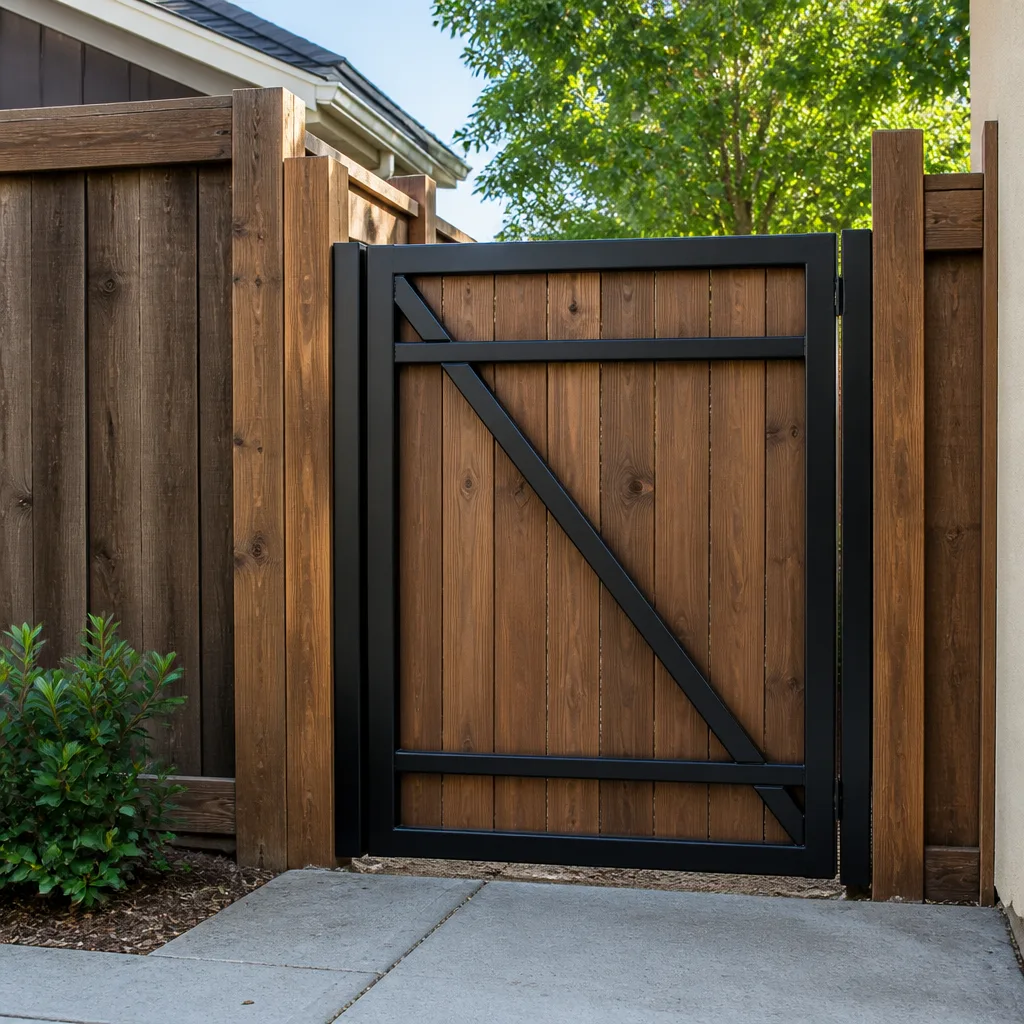 Wood & steel frame
 Farm & ranch
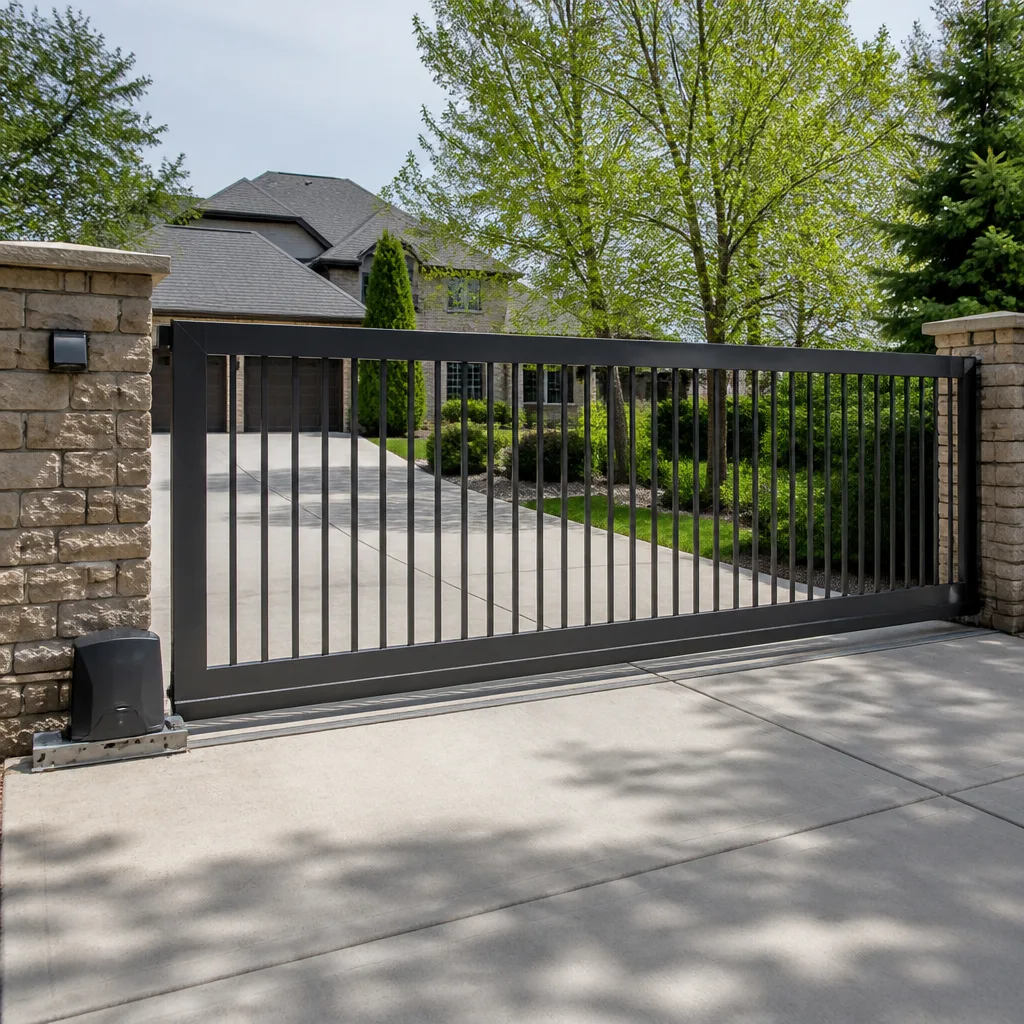 Sliding driveway gates
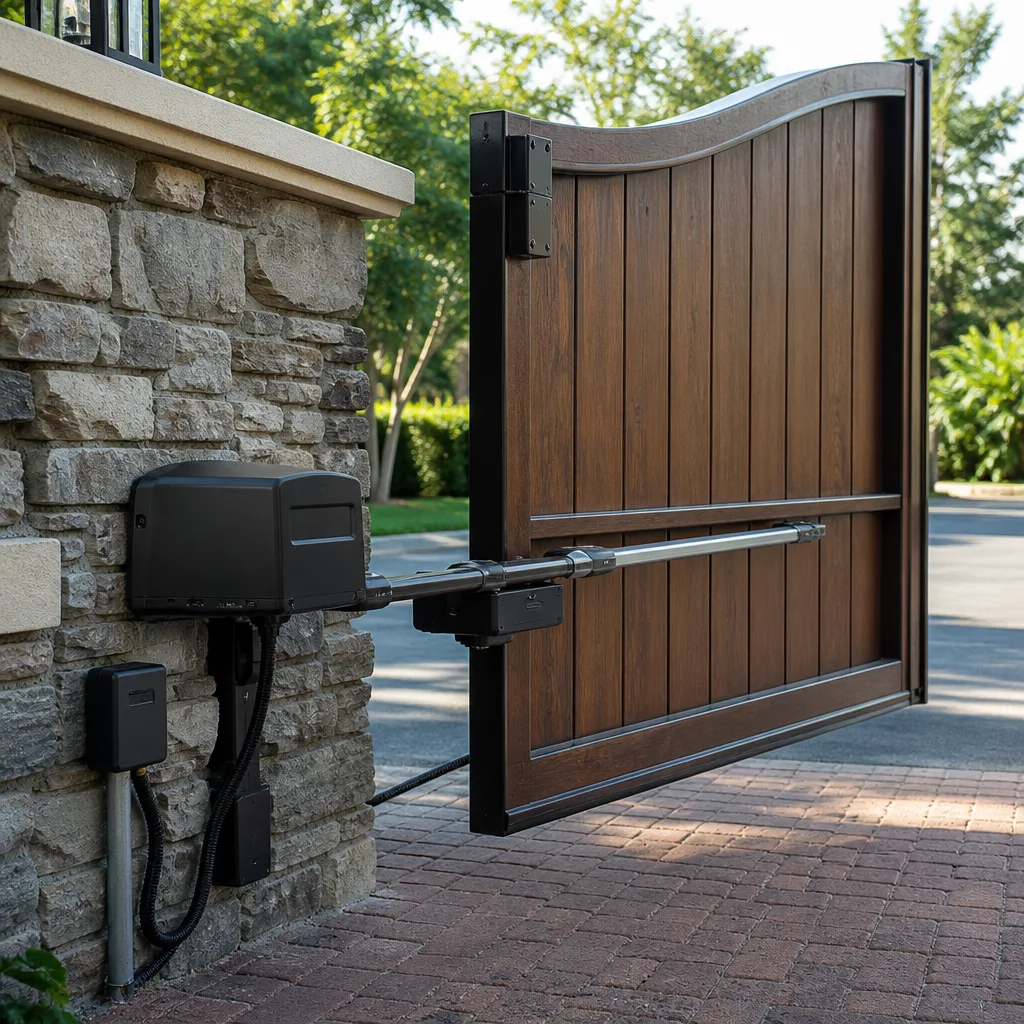 LiftMaster operators
Free on-site gate assessment - hinges, posts, and your LiftMaster or Nice gate operator checked before anything is quoted
The assessment is free and the quote is the invoice.
Get your free estimateGate Repair Maintenance Checklist for Miami Gardens Homeowners
Most Miami Gardens homeowners do the same thing when they hear a new squeak or feel a hitch in their automatic gate: they oil the hinges and hope it goes away. The problem is, the hinge isn’t where the failure is building. The number one item homeowners skip on every gate maintenance checklist, checking operator amp draw, is also the single best predictor of motor failure within 90 days. This guide is built around what actually fails in Miami Gardens gates, based on the failure patterns we see in our Gate Repair services in the field, not manufacturer boilerplate. You’ll learn what to inspect monthly, quarterly, and annually, what your specific gate brand struggles with in this humidity, and how to know whether a symptom is cosmetic or a warning sign of a motor about to quit.
Styles & brands we work with
Quick Answer
A proper Miami Gardens gate maintenance checklist runs on three cadences: monthly (visual inspection of hinges, wheels, and track debris), quarterly (operator amp draw check, battery load test, photocell beam alignment, terminal block corrosion inspection), and annually (ground connection testing, control board voltage check, full torque audit, weep hole clearing, and access system reprogramming). Homeowners should also feel comfortable handling lubrication and visual checks, while any electrical diagnostic work on operators, actuators, or control boards is safer when handled by a technician who knows your specific brand.
Table of Contents
- Why Miami Gardens Weather Is Harder on Gates Than You Think
- Monthly Maintenance Tasks (15 Minutes, No Tools Beyond a Rag)
- Quarterly Maintenance Tasks (The Amp Draw Check Most People Skip)
- Annual Maintenance Tasks (The System Audit That Adds Years to Your Gate)
- Swing Gate vs. Slide Gate: Why Your Maintenance Schedule Changes
- Battery Backup Systems: Load Testing, Not Just Indicator Lights
- Photocell Alignment Drift in Miami Heat
- Common Mistakes to Avoid
- When to Call a Professional
- Frequently Asked Questions
- The Bottom Line
Why Miami Gardens Weather Is Harder on Gates Than You Think
Miami Gardens sits a few miles inland from the Atlantic, which means your gate lives in a specific microclimate: hot, humid, salty air that rarely drops below 70 percent relative humidity, with afternoon thunderstorms that roll in heavy and leave standing water against gate posts. That combination attacks gate systems in three predictable ways.
First, moisture finds its way into terminal blocks and wiring connections. We’ll get into the specifics below, but the short version is that when copper connections sit in humid air, oxidation forms. That oxidation increases resistance. Increased resistance means the operator draws more current to do the same job. More current means more heat. Heat kills motors.
Second, the sun here is brutal on plastics and PCB coatings. Photocell housings warp. Operator covers crack. Rubber seals around control boards dry and shrink. A gate that worked flawlessly for five years suddenly throws error codes after a summer of direct exposure.
Third, the soil in Miami Gardens shifts with the wet-dry cycle. June through October saturates the ground. November through April dries it out. Clay-heavy soil expands and contracts, which can move gate posts a fraction of an inch. A quarter-inch of post movement at the base translates to a noticeable change in how the gate hangs and how hard the operator has to work.
We’ve worked on gates across Miami Gardens and the surrounding neighborhoods, and the failure patterns are consistent. LiftMaster operators that trip thermal overload from corroded connections. FAAC hydraulic units running slow because the fluid is past its service life. Mighty Mule swing arms bending under gates that have gained weight from rusting steel. Elite slide gates with wheels spalling because track debris wasn’t cleared. General maintenance advice written for Ohio or California does not prepare you for this environment. For Gate Repair Troubleshooting: Common Problems and How to Fix Them, see our dedicated guide.
Monthly Maintenance Tasks (15 Minutes, No Tools Beyond a Rag)
Monthly maintenance is visual and mechanical. You’re looking for change: things that moved, things that grew, things that wore. This is not a repair session. If you find something wrong, note it and either call us or watch it closely for two more weeks.
Here’s the monthly checklist, in order, because the sequence matters:
- Cycle the gate twice with the remote and watch for hesitation. A gate that starts slow, accelerates unevenly, or stutters is telling you something about motor load or power delivery.
- Wipe down the gate track (slide gates) with a dry rag. Remove leaves, sand, and the fine gray dust that accumulates here. Never use a hose to blast the track clean – you’ll push water into the operator.
- Check hinge bolts on swing gates. Grab the gate at the mid-point and give it a firm shake. If you feel play, the hinge bushings or bolts need attention. A loose swing gate transfers all that slop into the operator’s gearbox.
- Look at the gate in the closed position from the driveway side. Is it still level? A sag of even half an inch on a 14-foot gate means the hinge post or frame has moved.
- Clear anything growing around the gate’s path. Grass, saw palmettos, and the quick-growing vines we get in Miami Gardens will rub against the gate and create resistance. That resistance forces your operator to work harder.
- Listen. Stand next to the operator while it cycles. A healthy operator makes a consistent hum. A grinding, clicking, or pulsing sound is not normal, and it gets worse if you ignore it.
Fifteen minutes a month is all this takes. The payoff is that you will catch a hinge wearing out, a wheel chewing itself up, or a track filling with sand months before the operator burns out trying to push through it.
Quarterly Maintenance Tasks (The Amp Draw Check Most People Skip)
The single most overlooked diagnostic on a residential or commercial gate is the operator amp draw. This is a reading of how much current the operator motor pulls while the gate is moving. Every operator has a rated range. If your LiftMaster is pulling 6 amps on a run that should pull 3.5, something is creating resistance, and that something is usually a mechanical problem masquerading as an electrical one.
Here is the quarterly protocol we recommend, and it applies whether you do it yourself with a clamp meter or call us to do it. We’ll be direct: if you’re not comfortable working around energized control boards, skip the electrical steps and let a technician handle them. The high-voltage side of an operator can hurt you.
- Check operator amp draw with a clamp meter during a full open-and-close cycle. Compare against the spec plate on the operator. If draw is more than 20 percent above spec, you have resistance somewhere. The operator is working too hard, and that shortens the motor’s life.
- Torque-test the gate manually. Put the operator in manual release mode (most units have a lever or key release) and push the gate through its full travel by hand. It should move with consistent, moderate effort. If it binds partway, stops, or needs a hard shove at any point, you’ve found a hinge, wheel, or track problem. Fix the mechanical problem before it takes out the operator.
- Inspect every terminal block in the operator enclosure for oxidation. This is a Miami Gardens-specific step. Humid air plus salt means green or white crust builds on screw terminals. Tighten each terminal gently, and if you see corrosion, the terminal should be cleaned and the wire end re-stripped. Do this with the power OFF.
- Check ground connections. The ground lug inside the operator, the ground rod if you have one, and the ground wire on the motor housing all need clean, tight contact. A poor ground in this climate will cause phantom faults: gates that reverse for no reason, keypads that glitch, intercom hum, even circuit board failures that get misdiagnosed as board problems when the real issue is a losing ground.
- Clean and lubricate what needs it. For swing gates: hinge pins get a light machine oil. For slide gates: guide rollers and bearing points get the manufacturer-specified lubricant. Do not grease chains or belts unless your manual calls for it. A greasy chain in Miami Gardens collects sand and becomes an abrasive paste.
Quarterly maintenance is where you catch problems that haven’t announced themselves yet. A hinge that’s binding but not squeaking. A terminal that’s corroding but not failing. An operator drawing 5 amps now that will draw 8 amps in August. Every one of these is cheaper to address today than it will be in three months.
Annual Maintenance Tasks (The System Audit That Adds Years to Your Gate)
Once a year, your gate needs a full-system audit. This is not maintenance; it’s an inspection designed to find everything that’s wearing, drifting, or quietly failing, and to make a plan before any of it becomes a breakdown call.
We perform this audit on gates across Miami Gardens, including electric gate systems from FAAC, BFT, Elite, Ghost Controls, and DoorKing, though the checklist applies to virtually any automatic gate. Here’s what it includes:
- Full mechanical torque check. With the operator in manual mode, the gate is pushed through its full travel and resistance is felt at every point. Hinge wear, wheel bearing wear, track misalignment, and bent frame sections all show up here.
- Control board voltage test. The transformer output, the board’s regulated voltage, and the accessory voltage rail are all checked for stability. A control board running on low or irregular voltage will produce intermittent faults that look like bad limit switches.
- Limit switch verification. The open and close limits are tested, then re-tested under load. A limit switch that drifts means the gate slams harder every week, and that impact wears out rollers, hinges, and the operator gearbox.
- Photocell alignment and beam strength test. More detail below, but the short version is that Miami heat warps mounting brackets, and a photocell beam that has drifted just a few degrees will cause phantom reversals every afternoon when the sun hits the receiver.
- Access system test. Keypads, intercoms, telephone entry systems, loop detectors, and any smart-home integration are all exercised. Codes are checked. Loop sensitivity is checked. If your free-exit loop requires a vehicle to sit on it for two full seconds before triggering, it needs a sensitivity adjustment.
- Enclosure inspection. The operator enclosure is opened and the inside inspected for insects, gecko droppings, ants, rust, and wasp nests, all of which are standard Miami Gardens finds. Weep holes in the bottom of the enclosure are cleared so condensation has a path out.
- Battery backup load test. A proper load test, not just a green LED check. More on this below.
This is the single highest-value service a homeowner can schedule. It takes about an hour. It gives you a written list of everything that’s fine, everything that’s wearing, and everything that needs attention now.
Swing Gate vs. Slide Gate: Why Your Maintenance Schedule Changes
One of the mistakes we see homeowners make is applying the same maintenance routine to every gate type. That’s a problem, because swing gates and slide gates fail in different ways, and a maintenance schedule should be built around the failure modes of the specific gate you own.
Swing Gates: Focus on Hinges and Structural Load
Swing gates carry their entire weight on hinge posts and hinges. Every cycle, the gate loads and unloads those hinges. Over time, the hinges wear, the post can lean, and the gate can sag, which pushes the outer edge down and drags it against the ground or the latch post. Soil movement in Miami Gardens accelerates post lean, especially for gates on the east-west axis where wet-season ground saturation is most uneven.
Monthly, shake the gate for play and check for sag. Quarterly, check hinge bolts and bushings and manually cycle the gate to feel for binding. Annually, have hinge wear and post plumb checked. If your swing gate uses an articulated arm operator (like many Mighty Mule and FAAC units), the arm’s pivot points also need quarterly lubrication and annual inspection for slop. A worn arm pivot causes exactly the same operator strain as a worn hinge.
Slide Gates: Focus on Track, Wheels, and Debris
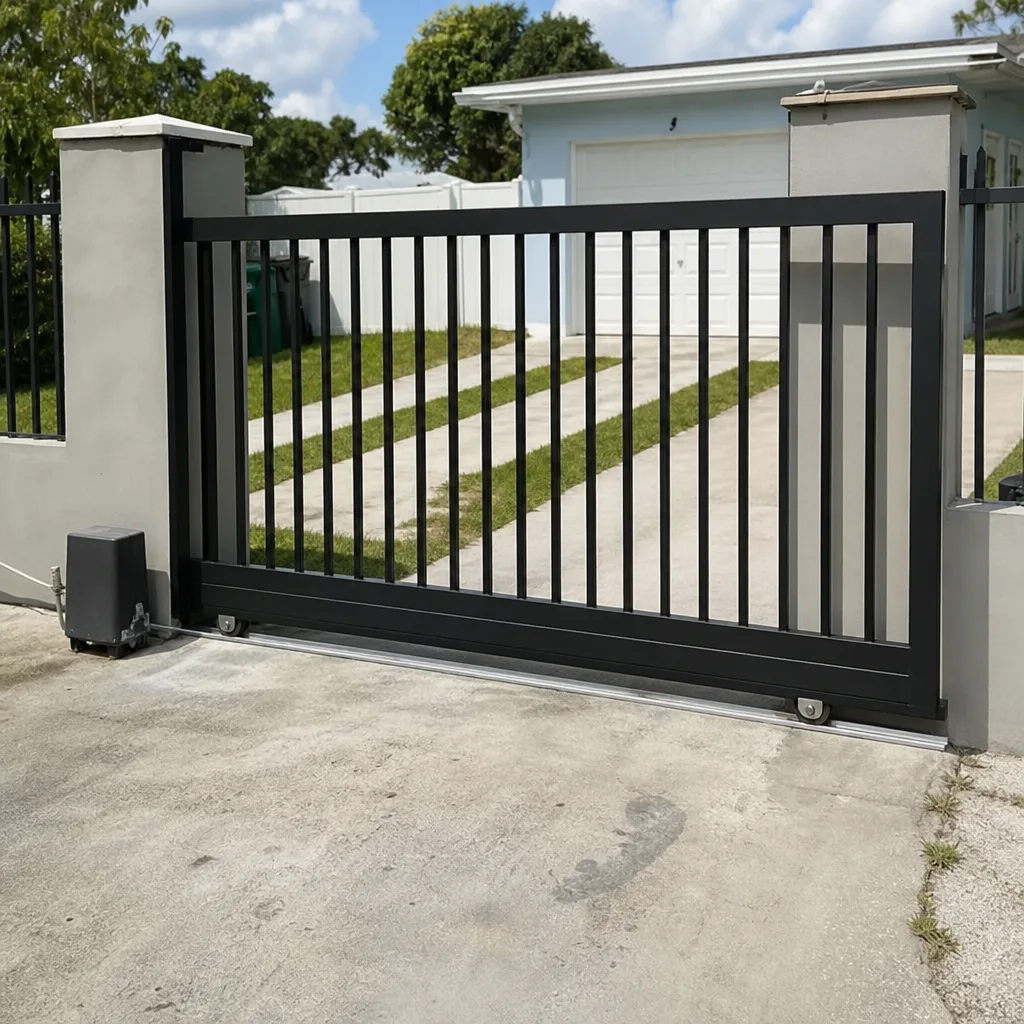
Slide gates carry their weight on wheels or a cantilever track, and they move along a rail. Their failure modes are about friction, not structural load. Sand, leaves, and the fine gray dust of Miami Gardens accumulate in the rail and grind against the wheels. Wheels develop flat spots. The rail wears thin in the middle of the travel path. Guide rollers get sloppy and the gate starts to wobble as it moves.
Monthly, clear the track and visually inspect wheels. Quarterly, check wheel bearings for play and lubricate according to the manual. Annually, measure rail wear and check the guide roller gap. A slide gate that has started to wobble is putting lateral load on the operator’s drive sprocket, and that’s how chains stretch, sprockets strip, and motors burn out.
If you’re unsure whether your gate is a swing or slide system, or what type of operator it uses, our Miami Gardens gate repair team can identify the system and recommend the right maintenance schedule for your specific setup.
Battery Backup Systems: Load Testing, Not Just Indicator Lights
There’s a specific moment when a homeowner discovers their gate battery backup is dead, and it’s never a convenient moment. It’s during a power outage after a summer thunderstorm, when the gate should still open for the car but instead sits there dark.
Most battery backup systems have an indicator light that glows green when the battery is connected. That green light is nearly useless. It tells you the battery is present and charging, not that the battery can actually supply the current needed to move a fully-loaded gate. We’ve load-tested backup batteries across Miami Gardens that showed a healthy green light but delivered 40 percent of their rated current. Under load, the gate would start to move, then stall halfway.
A proper load test means disconnecting the battery from the operator, connecting it to a load tester, and drawing current at the battery’s rated capacity for a specified period. A 12-volt 7-amp-hour battery should hold above 10.5 volts under a 3.5-amp load for at least five minutes. If voltage collapses quickly, the battery is sulfated and needs replacement. This is a quarterly task for homes that rely on gate access during storms and an annual task for everyone else.
Battery age also matters. In Miami Gardens heat, sealed lead-acid backup batteries rarely last beyond three to four years, regardless of use. If your battery is older than that and has never been load-tested, treat it as failed until proven otherwise.
Photocell Alignment Drift in Miami Heat
Photocells are the safety eyes on your gate: one unit emits an invisible infrared beam, the other receives it. Break the beam while the gate is closing and the gate should stop and reverse. The problem we see in Miami Gardens is that the mounting brackets for these photocells, usually plastic, warp under sustained heat and direct sun. When the bracket warps, the beam drifts off-axis. The receiver no longer sees the full beam strength, and the gate starts behaving erratically: reversing for no reason, not closing fully, or refusing to close at all on hot afternoons when the plastic is at its softest.
You can check beam alignment without special tools. Here’s the method we teach owners:
- Wait for full sun on a hot afternoon. Alignment issues often disappear in the morning when the plastic is cool.
- Check the indicator LEDs on both photocell units. Most brands have a green or red light on the receiver that shows whether the beam is strong, weak, or lost. If the light flickers or dims, the beam is marginal.
- Gently flex the bracket. With a finger, apply light pressure to the photocell housing and watch the receiver LED. If the beam strength improves, the bracket is the problem, not the photocell itself.
- Check for slow-growing obstructions. A palm frond, a clump of bougainvillea, or a parked car mirror that has been “there for months” can block a beam that used to be clear.
If the bracket has warped, the fix is to replace it with a metal bracket and re-aim the beam. Do not try to bend the plastic back. It will warp again within a season. If your gate uses photocells integrated into the operator, our electric gate repair service in Miami Gardens can diagnose whether the fault is in the photocell, the wiring, or the control board.
Common Mistakes to Avoid
- Lubricating the track on a slide gate. Grease or oil on a slide gate track captures sand and turns it into grinding paste. Tracks should be clean and dry; only specific bearing points get lubrication, and only with the product the manual specifies.
- Washing the gate and operator with a hose. Miami Gardens homeowners wash cars in the driveway, and the pressure washer gets pointed at the gate too. Water forced into the operator enclosure, keypad, or terminal block will cause corrosion and electrical faults. Use a bucket and rag, or a low-pressure rinse pointed away from electrical components.
- Ignoring a gate that has started to speed up. A gate that closes faster than it used to is not “working better.” It usually means the hydraulic fluid is low, a spring has broken, or the operator’s braking is failing. Speed changes in either direction warrant a professional look.
- Assuming a dead remote means a dead battery. It often does, but if you replace the remote battery and the gate still won’t respond, don’t keep clicking the remote at close range. You may have a receiver or control board issue, and repeated close-range transmission can mask interference problems.
- Using WD-40 on hinges and expecting it to lubricate. WD-40 is a water displacer and a light solvent; it will strip whatever lubrication was there. Use a proper hinge lubricant or a light machine oil.
- Overlooking the free-exit loop. The saw cut in your driveway with the loop wire buried in it is part of the gate system. If the loop sealant cracks and water gets in, the loop stops detecting cars reliably. The loop is a wear item in Miami Gardens, and it’s checked as part of an annual audit.
- Adjusting force settings to “fix” a binding gate. When a gate starts binding and struggling, turning up the operator’s force setting seems like the simple fix. All it does is push the motor harder against the same mechanical problem. The motor will fail sooner, and a failed operator from an overloaded motor is more expensive than fixing the hinge or wheel that started the problem.
When to Call a Professional
Some maintenance tasks are yours. The monthly visual checks, the track clearing, the wiggling and listening and watching, that’s all homeowner work and it will catch problems early. For more guides & resources, explore our blog. Other tasks need someone who knows what they are looking at, and more importantly, someone who can work safely around live 120-volt circuits inside an operator enclosure.
Call a professional when: the operator is tripping a breaker or GFCI; the control board shows an error code you don’t understand; the gate reverses unexpectedly and constantly during daylight hours; the gate smells hot after cycling; you hear arcing or popping from inside the operator; the gate moves with a shimmy or vibration it didn’t have before; or you have any doubt about terminal block corrosion and want a definitive answer rather than a guess. If your gate is from FAAC, LiftMaster, Elite, or any of the other brands we service, our technicians know the failure patterns for that specific unit and can tell you whether a repair or a replacement makes financial sense. Miami Gardens Gate Repair offers free estimates in Miami Gardens – call (855) 382-0732 to schedule a system audit.
Frequently Asked Questions
A monthly homeowner-level inspection costs nothing but time. A quarterly technical check that includes amp draw testing and terminal inspection typically runs between $80 and $150 if performed by a technician. A full annual system audit for most residential swing or slide gates in Miami Gardens runs between $150 and $300, depending on gate length, operator type, and access system complexity. The price is quoted and agreed before any work begins, so you know the number before we start. Call (855) 382-0732 for an exact quote – estimates are free.
You can if you have a clamp meter and are comfortable opening the operator enclosure around live voltage. The reading itself takes about a minute; the harder part is knowing what the reading means for your specific operator. Most gate operators list their rated amp draw on the spec plate inside the enclosure or in the manual. If you are not comfortable working near 120-volt connections, this is one task better left to a technician.
Quarterly for swing gate hinges and articulated arm pivot points, and quarterly for slide gate wheel bearings and guide rollers, using only the lubricant specified by the manufacturer. Miami Gardens humidity does not change the lubrication interval; what it changes is the cleaning interval, because fine sand and airborne salt settle on exposed lubricant and create grit.
That specific pattern usually points to thermal expansion or heat-related electronic drift. Plastic photocell brackets warp in direct afternoon sun. Control boards running hot will throw intermittent faults. Capacitors degrade faster at higher temperatures, and their performance degrades through the day. A gate that fails reliably every afternoon between 2 and 4 p.m. is not haunted; it’s heat-soaked, and a technician can generally isolate it to a specific component.
Yes, in the sense that operator enclosures need functioning weep holes, terminal connections need anti-corrosion treatment, and grounding must be robust. The standard weatherproofing installed at the factory is often not enough for this climate over the long term. Waterproof conduit connections, marine-grade wire connections, and elevated enclosure mounting for low-lying properties are all worth considering.
The most expensive way to own a gate in Miami Gardens is to fix it only when it stops working. Bearings that get replaced at the first sign of wear cost a fraction of an operator motor that burns out because the gate was dragged for six months. Two scheduled visits a year, one in late spring before storm season and one in early winter, will catch most of what this climate does to a gate. For homeowners who want that scheduled automatically, Miami Gardens Gate Repair will put you on a six-month service calendar.
The Bottom Line
The gates that survive longest in Miami Gardens are not the most expensive gates or the highest-torque operators. They are the gates that get looked at. Monthly, quarterly, annually, on the schedule laid out above, with attention to the failure modes this climate actually produces: terminal corrosion, ground degradation, photocell drift, battery sulfation, and mechanical resistance that shows up in the amp draw before it shows up anywhere else. Most of the monthly work is yours and free. The quarterly electrical checks and the annual system audit are worth every dollar, because a gate motor that fails in August after a storm is a security problem, an access problem, and an urgent bill all at once. For details on local requirements, see Gate Repair Permits, Codes & Inspections in FL: What You Need to Know. Keep the checklist running, and your gate will outlast its expected service life by years.
Written by the team at Miami Gardens Gate Repair, serving Miami Gardens since 2012.
See the difference
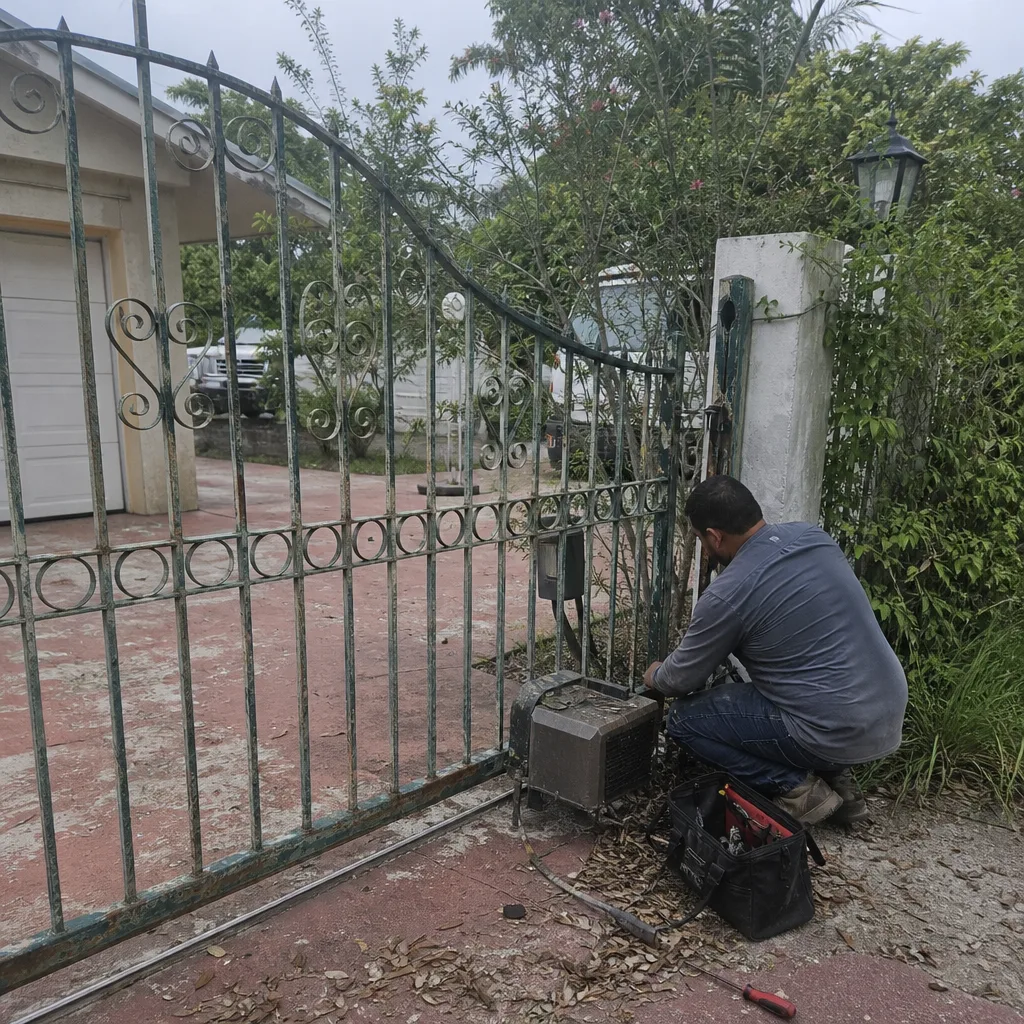 Before
 After
 Before
 After
 Before
 After